

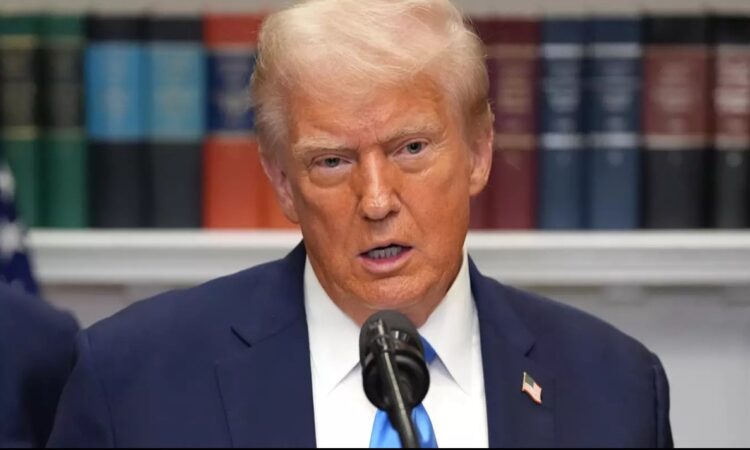
President Donald Trump announced that he has decided to pardon Juan Orlando Hernández, the former president of Honduras. Hernández is currently serving a 45-year prison sentence in the United States for drug trafficking.
Trump shared the news on Truth Social, saying that he was also supporting Nasry “Tito” Asfura in Honduras’ presidential election happening on Sunday. He wrote that if Asfura wins, the U.S. under his administration would strongly support his government. After that, Trump shifted the conversation to Hernández, saying he planned to give him a “full and complete pardon” because, in Trump’s view, Hernández had been treated too harshly and unfairly.
In typical Trump fashion, he wrote in all caps: “VOTE FOR TITO ASFURA FOR PRESIDENT, AND CONGRATULATIONS TO JUAN ORLANDO HERNANDEZ ON YOUR UPCOMING PARDON.”
But the situation is far more serious than Trump’s post made it sound. The Department of Justice had sentenced Hernández to 45 years after proving that he helped bring an almost unbelievable amount—around 400 tons—of cocaine into the United States. Prosecutors said he worked closely with his brother, Tony Hernández, who is already serving a life sentence for drug trafficking and gun crimes.
Journalists pointed out that Hernández’s crimes were not small mistakes. He accepted millions of dollars in bribes from dangerous drug traffickers, including people linked to the infamous Sinaloa Cartel. Many were stunned that Trump would free someone with such a heavy criminal record. Freelance journalist Thomas van Linge called the pardon “completely unacceptable,” especially because Honduras is heading into a very important election.
Former Attorney General Merrick Garland had been blunt about Hernández’s crimes when he was sentenced. He said that Hernández used his power as president to help run one of the biggest and most violent drug trafficking networks in the world, and both Honduras and the United States suffered because of his actions. Garland promised that the Justice Department would continue to go after drug traffickers, no matter how powerful they are.
Trump’s announcement shocked many people and caused a wave of criticism. Reporters, political experts, and even weather forecasters spoke out, saying it made no sense for Trump to pardon a convicted drug trafficker at the same time his administration is carrying out deadly and possibly illegal attacks on boats it claims are smuggling drugs.
Richard B. Simon, a senior instructor at Western Washington University, compared Trump’s actions to using the U.S. military to kill rival criminals while using presidential pardons to lift up criminals who are on his side.
Meteorologist Alan Gerard reacted with disbelief online, asking how the government could kill people merely suspected of drug trafficking while pardoning someone proven guilty of leading a major drug operation.
Attorney Bradley P. Moss mocked the contradiction, saying, “Trump: I will kill the drug cartels. Also Trump: Pardoning a powerful drug trafficker.”
Jeopardy! champion Hemant Mehta added that Republicans always say they want to punish drug traffickers, not free them—yet situations like this prove otherwise.
Trump did not give a clear explanation for the pardon. Still, Hernández has known ties to wealthy allies of Trump. One of them is billionaire Peter Thiel. According to a 2024 report from The New York Times, Thiel, along with OpenAI CEO Sam Altman and venture capitalist Marc Andreessen, had once worked with Hernández when he was in charge of Honduras’ congress. They teamed up to create a private city called Próspera.
Próspera was designed to be a “start-up city” run by private investors rather than a traditional government. It offered low taxes, very few regulations, and allowed businesses to choose their own rules from a list of over 30 countries or even design their own system.
This connection between Hernández and some of Trump’s wealthy supporters raised even more questions about why Trump would pardon someone with such a long list of serious crimes.
Many people across politics, journalism, and social media believe the pardon sends a dangerous message: that powerful criminals can escape consequences if they have the right connections.



How big of a payoff did Trump get for this action. It’s the only explainable reason for releasing such a vile man.
Well if Trump was selling citizenship for a price. What makes this so far fetched. Imagine this how much money he’s paying Trump and his people. Wait now Imagine how many US CITIZENS died already from the poison this guy has already brought in. How many love ones have already become addicted. Imagine how strong the Cartels are for them to be able to just buy the US government time and time again. Yes that includes Trump. You thought it only happened in third-world countries. No Trump just made us a Third-world country and it only gets worse. My family was military who fought for our country and are law enforcement, border patrol and state troopers and so on . And now our constitution is been trampled on while they swore an oath to protect it. While our government plays how much can we take with us before our term is up. I saw this with every president from Mexico. Now I see it with the best country in the world. And for anyone should care me and my family are US citizens born and raised .