
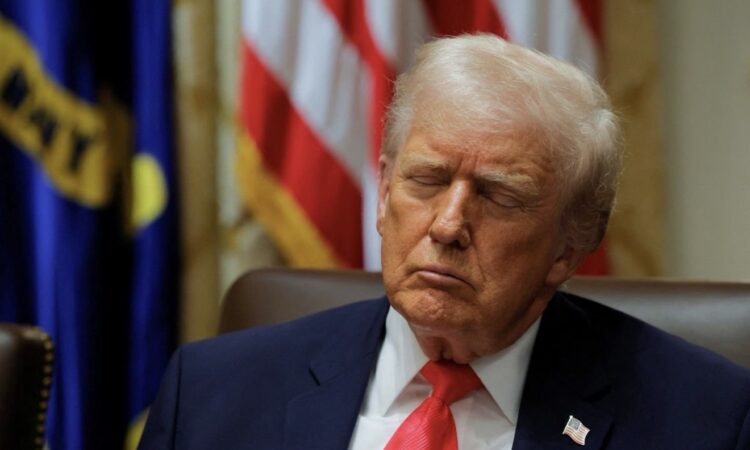
I still couldn’t sleep, even after trying to push the thoughts away. The words from Trump’s post kept replaying in my head, not just because they were cruel, but because of what they revealed about his state of mind.
This wasn’t just a lack of empathy or a bad joke made at the wrong time. It felt calculated, detached from reality, and disturbingly self-centered. Two people had just lost their lives in a violent and tragic way, and instead of acknowledging their humanity, Trump managed to turn their deaths into a story about himself.
What struck me most was how easily he reframed a brutal crime as proof of his own importance. In his version of events, Rob Reiner didn’t die because of violence or criminal wrongdoing. He died, according to Trump, because he was obsessed with Trump. That kind of thinking goes beyond arrogance. It suggests a warped view of the world where everything, even death, revolves around one man. That is not normal, and it is not harmless.
I kept thinking about how grief usually works. When someone dies, especially in such a shocking way, most people pause. Even enemies fall silent for a moment.
There is usually a shared understanding that some lines should not be crossed, that human life deserves at least a brief moment of respect. Trump crossed that line without hesitation. He didn’t just fail to offer comfort; he used the moment to insult, belittle, and elevate himself. That alone should have caused a national reckoning.
What made it even more alarming was how many people who rarely criticize Trump felt compelled to speak out. These weren’t just his political opponents or media critics.
They were allies, conservatives, and people who have defended him in the past. When people like that start saying “this is wrong,” it signals that something has shifted. It suggests that even those accustomed to his behavior are starting to see danger where they once saw spectacle.
Still, none of this was entirely new. Trump has spent years pushing boundaries, saying the unsayable, and daring the public to react. He insults the dead, mocks the disabled, degrades women, and attacks anyone he sees as disloyal. Over time, the shock fades. People grow numb. Outrage becomes routine, and routine outrage loses its power. That numbness is what scares me most.
Because underneath the noise, something deeper is happening.
I have seen presidents under stress. I’ve watched them age in office, become more cautious, more reflective, sometimes more withdrawn. Power weighs on people. It forces them to confront consequences, complexity, and limits. But with Trump, the opposite seems to be happening. Instead of becoming more grounded, he appears more detached. Instead of showing restraint, he leans harder into fantasy and grievance.
There is a sense now that he is no longer responding to reality as it is, but to a reality he has built for himself. In that world, he is always the victim and always the hero. Everyone else is either an enemy or a tool. Facts bend to his feelings. Violence, failure, and tragedy are reinterpreted as proof of his greatness. That kind of mindset is dangerous in anyone. In a president, it is terrifying.
When his chief of staff described him as having an “alcoholic’s personality,” it sounded like a slip of honesty. The idea that someone believes there are no limits, no consequences, no boundaries to what they can do is the very definition of unchecked power. That belief erodes judgment. It makes impulsive decisions feel justified. It turns recklessness into confidence.
And then there is the nuclear question, the one thought I didn’t want to face but couldn’t escape. The reality is stark and chilling. One person holds that power. One person’s mood, anger, fear, or pride could, in theory, change the course of human history in minutes. We like to believe there are guardrails, that cooler heads would intervene, that the system would protect us. But legally, that faith is fragile.
I kept asking myself uncomfortable questions. What happens if Trump feels humiliated on the world stage? What happens if he believes another leader is mocking him, challenging him, or making him look weak? What happens if he decides that the only way to reassert dominance is through force? These are not imaginary concerns when dealing with someone who sees everything through the lens of personal power and respect.
The most troubling part is that many people have stopped asking these questions at all. Trump’s behavior has become background noise. Each new outrage replaces the last. The public moves on, exhausted, distracted, or resigned. That emotional fatigue is dangerous. It creates space for escalation because nothing feels shocking anymore.
I don’t believe panic is helpful, but neither is denial. Acknowledging risk is not hysteria; it is responsibility. Democracies survive not by assuming leaders will always act wisely, but by building systems to respond when they don’t. Those systems exist for a reason, and moments like this are exactly why.
Removing a president from office is an extreme step, but so is ignoring clear signs of instability. The Constitution anticipated that there would be moments when loyalty, fear, or political convenience would clash with public safety. That is why mechanisms like impeachment and the 25th Amendment exist. They are not acts of revenge. They are acts of protection.
What frightens me is not just what Trump might do, but what we might fail to do. History is full of moments where warning signs were visible, spoken aloud, and then dismissed because confronting them felt too uncomfortable or too divisive. By the time action came, it was already too late.
I don’t want to live in a country where we wait for catastrophe before taking responsibility. I don’t want to believe that cruelty, paranoia, and delusion are acceptable traits in someone entrusted with the highest power on Earth. And I don’t want future generations asking why we saw the danger and chose silence instead.
If anything, the problem isn’t that people are overreacting. It’s that too many of us have learned how to look away.