Bad Bunny’s Super Bowl Halftime Show Was an All-American Triumph. Turning Point USA’s Was a Boring MAGA Grift With Kid Rock

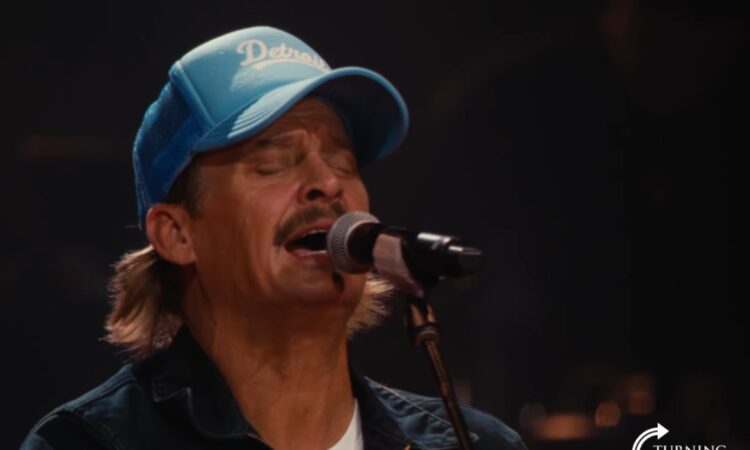
The first thing viewers saw when they joined Turning Point’s YouTube stream wasn’t music or celebration. It was a blunt sales pitch. A message telling people to “wear the mission” and text a number to buy official merchandise ran over and over again during a 15-minute countdown. A banner crawled across the bottom of the screen nonstop, pushing merch and begging viewers to sign up by text. Before a single note was played, it already felt less like a show and more like a fundraiser.
That tone ended up matching the rest of the night. The so-called All-American Halftime Show felt rushed, awkward, and oddly low-energy. The entire event only existed because of outrage from MAGA supporters who were angry that Bad Bunny, a Puerto Rican artist who sings in Spanish, had been chosen for the Super Bowl halftime show. Since they couldn’t openly say what really bothered them, the messaging leaned heavily on vague ideas of “patriotism” instead. Even so, Turning Point quietly revealed the subtext by asking fans what kind of music they preferred, with one option being “Anything in English.”
The result was a show that barely stirred any excitement. What followed were bland pop-country performances that felt small and uninspired, exposing how thin the talent pool was. Instead of feeling like a bold alternative, the event mostly landed with a shrug.
As the livestream audience climbed toward 5.5 million viewers, Brantley Gilbert’s guitarist opened with an electric guitar version of the national anthem. It was fine, but forgettable, the kind of performance that might earn polite claps and nothing more. Bathed in red light, Gilbert’s set continued with safe, twangy songs that felt emotionally hollow, as if all the feeling had been drained out.
The only truly jarring moment came during a rap verse in “Dirt Road Anthem,” which landed more awkward than exciting. Gilbert later said he took the gig imagining his kids watching him perform at halftime during the biggest game in American football. But this wasn’t that. What it really looked like was a calculated move to appeal to a niche MAGA audience and score praise on conservative media. It would have felt more honest if he’d just said that.
The show dragged on like an open-mic night that overstayed its welcome. The live chat filled with bunny emojis, mocking the event and clashing with the stiff, RNC-style stage setup. Lee Brice followed with a short set that felt as flat as its final song title, “Hard to Love.” Gabby Barrett’s brief appearance didn’t help much either, reinforcing the sense that neither performer was ready to carry a major moment. Their apparent attempt to align with the MAGA crowd felt less like conviction and more like a last-ditch career strategy.
The night’s biggest name, Kid Rock, was the clear headliner and, for a moment, he delivered. He came out with energy, bright lights, a giant flag, and a massive fur coat. For a brief stretch, it was almost fun watching him revisit “Bawitdaba,” a rap-rock song that’s been around for decades. Wearing a fedora and jean shorts, he looked like a loud, lovable uncle halfway through a karaoke night at a Florida bar.
Then it fell apart. Instead of committing to the performance, he seemed to lose interest, casually abandoning the backing track and effectively stopping mid-song. It was strange, messy, and oddly revealing. It ended up being the only genuinely unexpected moment of the entire broadcast.
After that, a classical duo appeared for a long string interlude, which only slowed the momentum further. Kid Rock was then reintroduced using his full legal name, Robert James Ritchie, as if that alone would add gravity. He returned to perform a serious cover of “Til You Can’t,” turning the mood somber and heavy. It felt like the kind of moment that would make viewers reach for another drink rather than lean in emotionally.
What makes this all more ironic is Kid Rock’s political past. Before MAGA, his biggest political moment was campaigning for Mitt Romney in 2012, a fairly dull and forgettable run. His music last made a serious impact on the charts years ago, but his full embrace of Trump in 2016 gave him a new kind of relevance. Since then, he’s stayed visible by attaching himself to partisan politics, performing for wealthy donors, and showing up at political events where his music feels out of place. If the Trump brand can sell hats and flags, why shouldn’t others cash in too?
While the Turning Point show loudly wrapped itself in patriotic slogans, Bad Bunny’s official halftime performance showed a very different version of America. It celebrated diversity without shouting about it. The visuals highlighted everyday people, workers, elders, friendships, dancing, joy, and shared energy. Even without understanding the lyrics, the message came through clearly: this is a country built by people with different backgrounds, cultures, and talents.
There was far more there for critics to enjoy than they’d ever admit. A real wedding took place on stage. There were joyful celebrations, beautiful dancing, and even a bold “God Bless America” moment. But none of that mattered, because there was never any intention to engage with the performance honestly.
Right on cue, Donald Trump fired off a post attacking the show just minutes after it ended, dismissing it as something no one could understand. Complaining about Spanish lyrics missed the point entirely, but outrage was always the goal, not understanding.
In the end, the contrast between the two broadcasts couldn’t have been clearer. Bad Bunny’s performance ended with a massive screen displaying the words, “The only thing more powerful than hate is love.” The Turning Point stream closed with something very different: a message urging viewers to “get involved,” alongside a QR code asking for more money.