
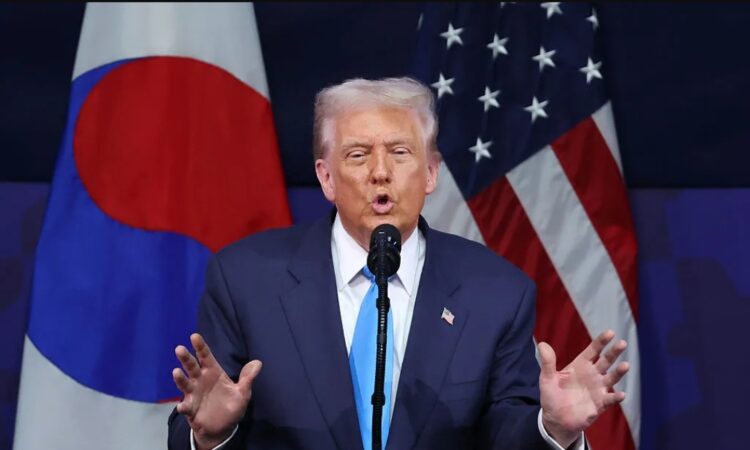
Donald Trump recently stood on a stage in Pennsylvania, at a rally that was supposedly about the rising cost of living, and claimed that Black people love him. That statement alone says a lot, and none of it is good. It wasn’t relevant to the topic, it wasn’t true, and it showed once again how casually he uses Black people as props whenever it suits him.
Trump has a long history of doing this. Whenever he feels cornered or wants to look inclusive, he suddenly starts talking about unnamed Black supporters, imaginary crowds of Black voters, or some random Black person he claims agrees with him. It’s the same routine every time. He doesn’t speak to Black people, he speaks over us, and usually about us, in ways that are insulting and dishonest.
At this rally, instead of focusing on affordability, Trump spent most of his time bragging about himself, attacking immigrants, insulting President Biden, and throwing out racist talking points. Then, out of nowhere, he claimed that Black people love him and that he received huge support from Black voters. He even said Black people “know a scam better than anybody,” which is not only offensive but also reveals how he stereotypes us while pretending to compliment us.
The facts completely contradict his claims. In the most recent election, the vast majority of Black voters supported the Democratic ticket. Trump only received a small percentage of the Black vote, just as he did in previous elections, and that support has not grown. In fact, his actions during his second term have pushed many Black voters even further away.
What makes his claims especially frustrating is how clearly his policies and rhetoric show disregard, and often outright hostility, toward Black communities. His administration has focused heavily on appealing to white resentment while rolling back programs meant to address racial inequality. He has attacked diversity, equity, and inclusion efforts across the country, cut or threatened funding for historically Black colleges and universities, and supported policies that limit how Black history is taught or acknowledged.
His Justice Department has gone after colleges for trying to hire diverse faculty, ended police accountability agreements that came after the killings of George Floyd and Breonna Taylor, and dismissed environmental justice concerns in predominantly Black communities. At the same time, that same department approved a large settlement for the family of a January 6 rioter, showing a stark contrast in whose grievances are taken seriously.
Trump has also pushed the idea that Black people want more police and military presence in their neighborhoods, even claiming that Black women are begging him to send troops into cities like Chicago. This is especially disconnected from reality given that Black women have consistently been one of the strongest voting blocs against him. His version of Black support exists almost entirely in his imagination or on television screens that reflect his own biases.
Even when Trump tries to compare his legal troubles to the long history of discrimination against Black Americans, it comes across as deeply manipulative. He suggests that Black people relate to him because he feels persecuted by the justice system, while ignoring the fact that he has spent years denying systemic racism exists and actively working to dismantle efforts meant to address it. He wants sympathy for himself while stripping away protections and opportunities for others.
The pattern is clear. Trump only acknowledges Black pain when it benefits him politically, and even then, he reduces it to stereotypes and sound bites. His policies, his appointments, and his rhetoric all point in the same direction: he does not prioritize Black well-being, Black voices, or Black progress.
So no, Black people do not love Donald Trump. And even if a small number do support him, his actions make it clear that he does not love Black people in return. What he loves is the idea of using us as a talking point, a shield against criticism, or a convenient lie to tell from a podium.
The least he could do is stop putting words in our mouths.