
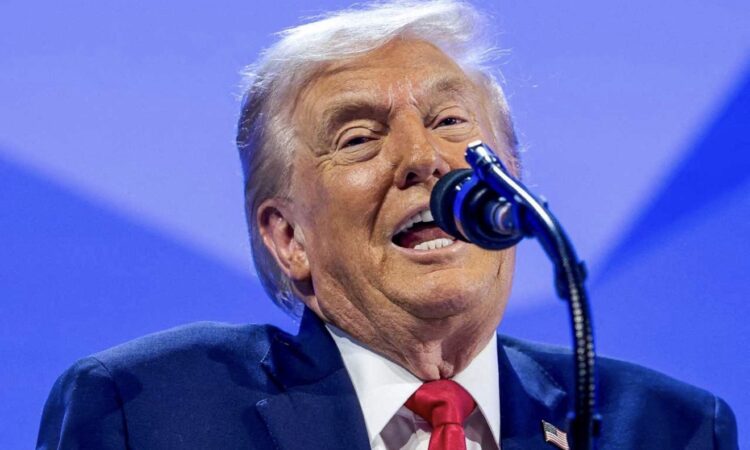
As I was writing this piece, Donald Trump was on stage at the World Economic Forum in Davos. Davos has long been criticised as a playground for the global elite a place where billionaires and powerful politicians fly in on private jets, talk about climate change and inequality, and then fly home without much changing. Those criticisms are often fair.
This year, though, Davos felt different. It became a focal point for the confusion, fear, and tension created by Trump’s ongoing attacks on NATO, his hostility toward Europe, his strange demand for a Nobel Peace Prize, and his repeated obsession with taking control of Greenland.
During a long, rambling speech filled with exaggerations and outright falsehoods about his achievements, Trump appeared to back away from the idea of using military force to seize Greenland. This came after days of suggesting he might take it “the hard way” if necessary. Instead, he said he wanted “immediate negotiations” to acquire Greenland because, in his words, it is “undefended.” He also repeated claims that Russian and Chinese ships are surrounding the island claims that have no factual basis.
Was this another case of Trump backing down after making dramatic threats? Possibly. But it would be a mistake to think this pattern is over. He has shown time and again that he is willing to raise the risk of global conflict, hint at catastrophic consequences, and then demand praise or awards in exchange for simply not starting a war. It’s a familiar routine now: Trump makes outrageous claims, the media amplifies them, and real diplomatic relationships are damaged in the process.
The reality is simple. Greenland is part of NATO through Denmark, and that means it is already defended by the alliance including the United States. The idea that it is somehow exposed or abandoned is nonsense. The entire episode exists mainly to feed Trump’s ego and his desire to “own” something big and symbolic, something he could brand and boast about. It is hard not to imagine him wanting to rename it after himself.
This behaviour fits a broader pattern. Trump continues to undermine his own country while stirring chaos abroad. He has sent violent supporters into American cities, inflamed domestic tensions, and consistently avoided accountability over issues like the Epstein files. The damage is not accidental; it is the result of leadership driven by self-interest rather than responsibility.
Meanwhile, the rest of the world is adjusting. That shift was captured clearly in a major speech at Davos by Canada’s Prime Minister, Mark Carney. His message was blunt: the global order has changed. The United States is no longer seen as a reliable partner. It cannot be trusted to honour agreements and is increasingly willing to use tariffs, economic pressure, and threats to get its way.
This new reality is painful, especially for countries that have long considered the U.S. a close ally. But the people who may suffer most are Americans themselves. As Trump tears up trade deals and alienates partners, other countries are moving forward without the U.S., forming new alliances. Many of the Americans who voted for Trump hoping for cheaper living costs and economic relief are instead facing higher prices, fewer opportunities, and growing isolation.
The damage is already visible in the auto industry. As journalist Ryan Cooper has reported, Trump’s decision to roll back government investment in green energy under the Inflation Reduction Act has badly hurt American carmakers. By waging war on electric vehicles and embracing erratic trade policies, the industry is bleeding jobs and market share.
Take Canada as an example. It has traditionally been one of the biggest buyers of American cars. The two countries’ auto industries are deeply connected, and Canadian consumers have historically been loyal to U.S. brands especially large trucks.
But that relationship is breaking down. America’s share of the Canadian auto market has fallen sharply, from about half a decade ago to just over a third today. Trump’s trade wars and even his talk of annexing Canada have triggered a strong nationalist backlash, including boycotts of American products.
This brings us back to Carney’s speech, which urged world leaders to stop clinging to a romanticised version of the past. He argued that the world is not slowly transitioning into something new it has already fractured.
Over the last twenty years, crises in finance, health, energy, and geopolitics have exposed the risks of extreme global interdependence. More recently, powerful countries have started using that interdependence as a weapon, turning trade, supply chains, and financial systems into tools of pressure and control.
Carney’s point was clear: cooperation only works when it is genuinely mutual. When integration becomes a way for powerful countries to dominate weaker ones, it stops being a benefit and becomes a trap. Many global institutions that smaller and mid-sized countries relied on the WTO, the UN, climate frameworks, and other shared systems are under strain. As a result, countries are seeking greater independence in energy, food production, critical resources, finance, and supply chains. That instinct, he said, is entirely understandable.
A country that cannot feed itself, power itself, or defend itself has very limited choices. When international rules no longer protect you, you are forced to protect yourself.
Carney called on the world’s “middle powers” — countries that are neither superpowers nor insignificant to work together economically, militarily, and politically. Acting alone, they are vulnerable. Acting together, they can become a force that stands up to the largest powers. He pointed to concrete steps already being taken, including new trade and security agreements with the European Union, China, Qatar, and countries across Asia, Africa, and South America.
While the U.S. pulls back and lashes out, many of its former partners are building new relationships. As Carney explained, this is not about ideology or resentment it is about survival. Countries like Canada cannot afford to depend on a partner that may turn hostile overnight.
He summed it up with a stark warning: if middle powers are not at the table helping shape the world, they risk becoming targets instead. His message was not one of despair, but of realism. The old global order is not coming back, and pretending otherwise is pointless. Nostalgia, he said, is not a strategy.
Instead, he framed this moment as an opportunity — even a form of liberation. From the current fracture, something stronger, fairer, and more cooperative could be built. The most powerful countries will always have their power. But others still have the ability to face reality, strengthen themselves at home, and work together honestly.
Carney ended by inviting any country willing to take that path alongside Canada. The audience of business and political leaders responded with a standing ovation.
Trump, meanwhile, will continue to rant, exaggerate, and lie whenever he gets a microphone. But with each performance, he makes both himself and the United States less relevant. Much of the world is no longer waiting for Washington to regain its balance. It is moving on.
By forcing this shift, Trump is weakening America day by day. Whether the country can recover will depend on future elections, on voters rejecting those who enable him, and on whether a future president can rebuild trust that has been badly damaged. Even then, restoring America’s standing in the world will be a long and difficult task.