
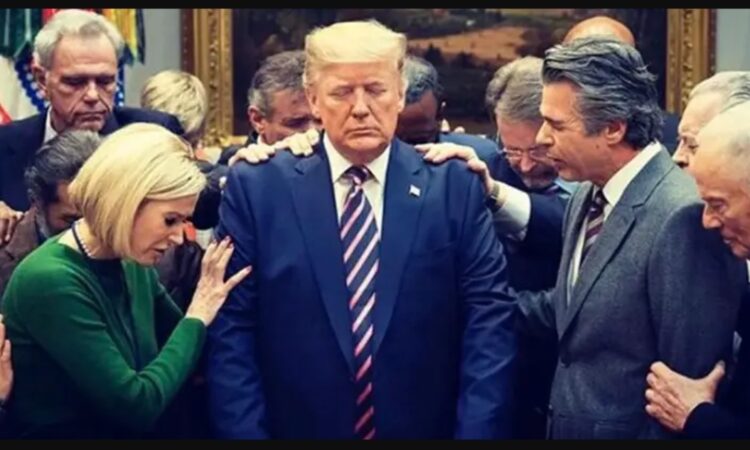
Evangelical pastors were shown praying over Donald Trump in an official White House photo. Around the same time, Trump urged Republicans to pass the SAVE Act “for Jesus,” though the situation might have made more sense if he had instead openly referenced figures like George Wallace and Strom Thurmond, who were closely tied to past efforts to limit voting rights.
A lot of the discussion about this bill has focused on how harmful it could be right now. But the SAVE Act is not something new that came out of nowhere. It builds on years of efforts by Republicans to restrict voting, going back about 25 years. Even if this particular bill doesn’t pass, similar ones are likely to keep coming, so it’s important to understand the bigger picture and the history behind it.
The bill would make voting harder in several ways. It would require people to show documents like a passport or birth certificate to register and vote, while not accepting many common forms of ID like student cards, most driver’s licenses, or certain tribal IDs. More than 21 million Americans don’t have easy access to the required documents, and people from Black, Latino, and Asian communities are much more likely to be affected.
It would also make it much harder to run voter registration drives in person, because election officials would need to see original proof of citizenship, and outside groups wouldn’t be allowed to help submit that proof. On top of that, registering online or by mail would become much more limited.
The bill would require voter rolls to be updated every 30 days, which could lead to people being wrongly removed just before an election. It would also give government officials access to voter data in ways that could be misused by those in power.
Looking back, there is a long history of similar actions. In the 2000 presidential election, Florida removed about 12,000 voters—mostly African Americans from voting lists by wrongly labeling them as former felons. At the time, laws rooted in the Jim Crow era prevented people with felony records from voting. The election in Florida was decided by just 537 votes, which helped determine the presidency. Even years later, many former felons in Florida still cannot vote, despite efforts to restore those rights.
In 2004, similar issues came up in Ohio. Hundreds of thousands of voters, again mostly African American, were removed from the rolls. Some people were also blocked from registering because of technical issues, like using the wrong type of paper. Early voting locations were limited, which led to extremely long lines in major cities.
In 2013, the Supreme Court struck down key parts of the Voting Rights Act that had protected against discrimination. Soon after, several Southern states passed stricter voting laws.
For example, North Carolina introduced rules that rejected certain types of ID, reduced early voting time, ended same-day registration, and made it harder for people to vote if they went to the wrong location. Some polling places, especially on college campuses, were also moved or removed. A federal court later said these changes targeted African American voters very precisely.
Other states like Texas, Mississippi, Alabama, and Georgia passed similar laws. In Georgia alone, over half a million voters were removed from the rolls in 2017, including many who simply hadn’t voted recently. These kinds of changes led to noticeable gaps in voting rates between white voters and voters of color—gaps that hadn’t been there before.
Supporters of these laws often say they are meant to prevent voter fraud. However, actual cases of voter fraud are very rare. A major investigation during the Bush administration found only a small number of cases nationwide, and many of those involved simple mistakes. Even studies by conservative groups have found very few confirmed cases of non-citizens voting.
In reality, laws like these don’t stop the most determined voters, who will find a way to participate. But they do make things harder for many others. It’s like adding obstacles to a race—top athletes might still finish, but others may struggle or give up altogether.