Donald Trump could soon suffer stinging court loss as major case on ‘life support’: expert

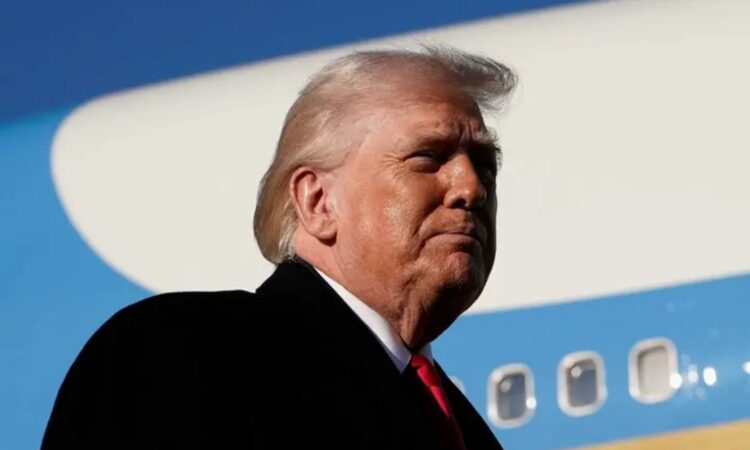
President Donald Trump was photographed watching as he prepared to board Air Force One at Pope Army Airfield at Fort Bragg in North Carolina on February 13, 2026. He was heading to Florida at the time. While the image showed a routine moment of travel for a sitting president, a significant legal issue involving his administration was unfolding in the background, one that could soon lead to another serious setback in court.
According to legal observers, a major criminal case that the Trump administration has been pursuing is now in deep trouble. One legal expert described the case as being on “life support,” meaning it is barely holding together and could collapse at any moment. That expert, Michael Popok, is a lawyer and the host of the Legal AF podcast. He has been closely following the case and believes the government’s position has weakened over time instead of becoming stronger.
The case centers on Kilmar Abrego Garcia, a Maryland resident who has temporary protected status in the United States. Temporary protected status allows individuals from certain countries facing dangerous conditions to live and work legally in the U.S. for a limited time. The Trump administration has accused Abrego Garcia of being involved in human trafficking and has attempted to prosecute him for nearly a year. However, the situation became more complicated when the administration acknowledged that it had mistakenly deported him to El Salvador in May.
After being deported, Abrego Garcia was detained in El Salvador’s CECOT prison, a facility known internationally for its harsh conditions and strict security. He reportedly spent several weeks there. Overall, he was outside the United States for about seven months before being returned. Once he came back to the U.S., the Trump administration moved to restart its criminal prosecution against him, this time filing the case in Tennessee.
Michael Popok has argued that the government’s repeated legal losses in the case have put it in a very weak position. He explained that every time the court rules against the administration, it gives Abrego Garcia’s legal team more leverage. In other words, the defense gains stronger ground to negotiate a better outcome, which could include reduced charges, a favorable settlement, or even a full dismissal of the case. Popok suggested that the government’s setbacks make it harder to justify continuing the prosecution.
Back in October, District Judge Waverly Crenshaw made an important ruling. He stated that Abrego Garcia’s lawyers had shown a “reasonable likelihood” that the prosecution might be vindictive. In simple terms, that means there is credible concern that the charges could have been filed out of retaliation or improper motives rather than based purely on solid evidence and fair legal reasoning. A finding like that does not automatically end a case, but it raises serious questions about whether the prosecution is acting appropriately.
Popok believes that when the case returns to Judge Crenshaw’s courtroom later this month, the judge may decide to dismiss it altogether. If that happens, it would represent another significant legal defeat for the Trump administration and could draw further scrutiny about how the case was handled from the start.
Another major issue in the case involves the administration’s claim that Abrego Garcia is connected to the violent MS-13 street gang. The government has suggested that he is affiliated with the gang, which is known for serious criminal activity. However, Popok pushed back strongly against that accusation. He said that every court that has examined the evidence so far has found no proof that Abrego Garcia is a gang member. He also rejected claims that Garcia is a “narco terrorist,” calling those labels unsupported by reliable evidence.
Popok further argued that the witnesses who testified against Abrego Garcia had credibility problems. According to him, many of these individuals were dealing with their own legal troubles and were trying to reduce their sentences or secure favorable treatment from the government. Because of that, he suggested their testimony may have been influenced by personal interest rather than truth. In his view, relying on such witnesses weakens the government’s case even more.
As the case moves forward, all eyes will be on Judge Crenshaw and his next decision. If the court determines that the prosecution was indeed vindictive or lacking solid evidence, the case could come to an abrupt end. That outcome would not only affect Abrego Garcia’s future but could also raise broader questions about how the administration handled the deportation, the detention in El Salvador, and the decision to continue pursuing charges after bringing him back to the United States.