
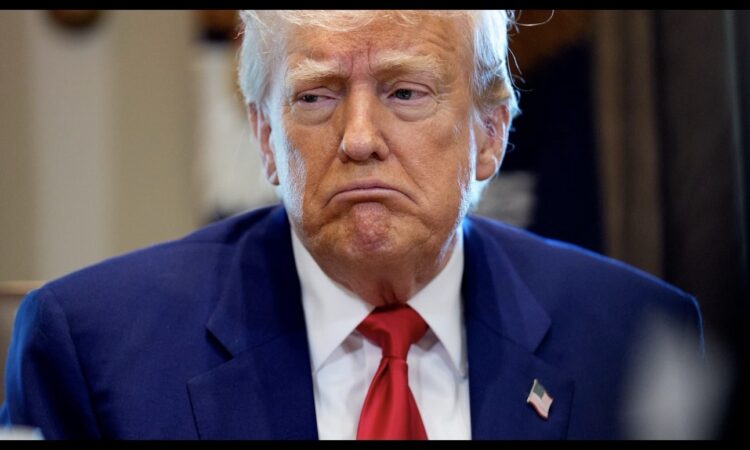
There is now very little room left to argue that the president is fully able to handle the responsibilities of his job.
Donald Trump has sent a diplomatic message so strange and alarming that it is worth reading carefully just to understand how serious the situation has become. The letter was addressed to Jonas Gahr Støre and focused on Trump’s anger over not receiving a Nobel Peace Prize.
In the letter, the 79-year-old president complained that Norway did not give him the prize for what he claimed was stopping “8 wars plus.” Because of this, he said he no longer felt bound to think mainly about peace, and instead would focus on what he believes is best for the United States. He went on to question why Denmark should have any right to Greenland, suggesting there was no real proof of ownership and claiming the U.S. had just as much historical claim to it. He also insisted that Denmark could not protect Greenland from Russia or China, and argued that the world would not be safe unless the United States had “complete and total control” of the territory.
Even by Trump’s own long history of extreme statements, this letter crosses into dangerous territory. It shows a mindset that appears detached from reality. Starting or threatening conflict because of personal disappointment over a prize he was not eligible to receive is not rational behavior. Undermining long-standing alliances and weakening global security because of hurt feelings is even worse.
The letter also reveals a deep misunderstanding, or disregard, of how NATO works. Greenland is not protected by Denmark alone. It is protected by the NATO alliance, which is built on collective defense. An attack on one member is treated as an attack on all. That shared strength includes the United States, the United Kingdom, Canada, and much of Europe. This system is precisely what has kept Greenland secure for decades.
Yet Trump appears willing to tear apart this alliance and risk pushing the world toward a global conflict simply because the Norwegian Nobel Committee — an independent body that does not answer to Norway’s government — did not bend its rules to reward him. His claims about stopping multiple wars are widely disputed and, in many cases, appear to exist only in his own imagination.
These are not the thoughts or calculations of a stable leader. They read more like a fantasy that even figures such as Vladimir Putin or Xi Jinping would not have expected to see play out in reality. And yet, here it is, coming directly from the president of the United States.
Over the past year, Trump’s behavior has repeatedly pushed boundaries that once seemed impossible to cross. News outlets have spent enormous amounts of time fact-checking his claims because so many of them are plainly false — from imaginary investments, to bizarre statements about wind turbines, to wars that never happened. At times, it is difficult to tell whether these are deliberate lies or beliefs he genuinely holds.
Alongside these claims, there have been growing concerns about his health. Observers have noted visible physical issues, such as bruising, swelling, and frequent fatigue. There have also been repeated reports of him falling asleep during important meetings. Some medical professionals have suggested that his public behavior shows signs of cognitive decline that could be consistent with serious neurological problems.
By most accounts, Trump does not live a healthy lifestyle. He relies heavily on fast food and medication, stays awake late into the night scrolling through social media, and spends holidays angrily posting online. This pattern only adds to concerns about his ability to lead effectively.
Because of all this, many argue that impeachment alone is not enough. Impeachment is a political process designed to punish wrongdoing like corruption or abuse of power. While Trump’s actions would almost certainly qualify under those standards, the deeper issue is whether he is mentally and physically capable of continuing in office at all.
He has already taken actions that would have ended the career of any other president. These include deploying heavily armed forces into American cities, openly talking about canceling elections, pressuring allies with economic threats to give up their territory, trying to jail political opponents, and engaging in military actions without proper approval.
He has even floated the idea of creating a new international organization to rival the United Nations, reportedly called the “Board of Peace,” with himself in charge and a billion-dollar entry fee. Despite portraying Russia as a serious threat, he has reportedly invited Putin to participate, which only deepens the contradictions in his thinking.
All of this makes his threats over Greenland even more alarming. The issue is no longer just about bad judgment or reckless policy. It is about a president who appears unable to separate personal grievances from national and global security decisions.
The 25th Amendment to the U.S. Constitution exists precisely for situations like this. It allows the vice president and a majority of the Cabinet to declare that a president is unable to carry out the duties of the office. If the president objects, Congress can decide the matter with a two-thirds vote.
The amendment was created after the assassination of John F. Kennedy, when the country realized how unprepared it was for a sudden loss or incapacity of a president. The chaos and uncertainty of that moment led lawmakers to put clear rules in place.
In Trump’s case, invoking the 25th Amendment would be difficult. His Cabinet is filled with loyalists, and many Republican lawmakers are unwilling to challenge him, even when his actions are deeply unpopular. There is also debate about whether replacing him with JD Vance would lead to meaningful change, given Vance’s support for many of Trump’s policies.
Still, the question cannot be avoided. What is happening goes beyond politics. The behavior on display reflects a wider culture of denial within the MAGA movement, where obvious facts are rejected in favor of a shared alternative reality.
Removing Trump under the 25th Amendment may not be politically easy, or even likely, but it is a constitutional option that deserves serious discussion. Ignoring it means accepting a dangerous illusion — one that risks not only American democracy, but global stability as well.