
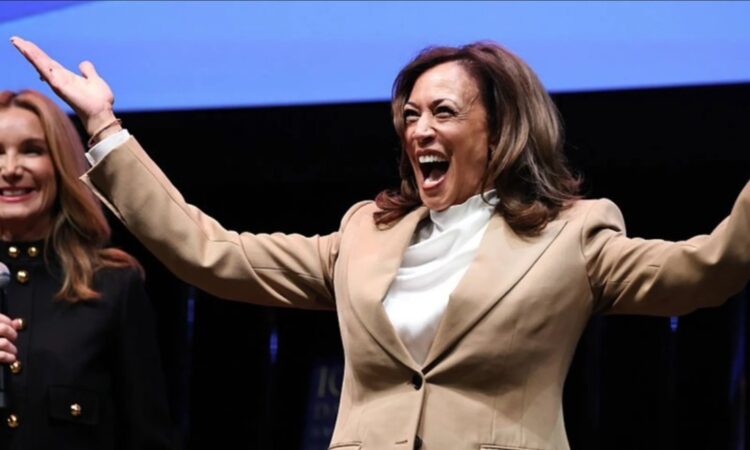
Former U.S. Vice President Kamala Harris is starting to get more attention again as someone who could run for president in the 2028 election. New polling and political analysis suggest that many Democratic voters may actually be more open to a practical, moderate leader than people often assume.
Even though the party is sometimes portrayed as very progressive, the data shows that a large portion of Democratic voters prefer a balanced and realistic approach to governing rather than extreme policies.
A recent analysis of survey data from the Manhattan Institute looked at the makeup of Democratic voters and found that the group is more mixed and divided than it might appear from the outside. According to the study, the biggest group within the party prefers leaders who focus on common-sense solutions and middle-of-the-road policies. These voters are not necessarily looking for dramatic political changes but instead want steady leadership and gradual improvements in areas like immigration, crime, education, and social policy.
In the same analysis, Harris came out on top in an early poll of possible Democratic candidates for the 2028 presidential primary. She received about 23 percent support from Democratic primary voters. Close behind her was Gavin Newsom, the governor of California, who received around 20 percent. While these polls are still very early and can change over time, they show that Harris is already seen as one of the main figures who could compete for the Democratic nomination.
Researchers involved in the survey said the results suggest that the average Democratic voter may actually be closer to the political center than many people think. Because of that, a candidate who is widely known, experienced, and seen as relatively moderate could have an advantage. Harris fits that description for many voters because she has strong national name recognition and has spent years in high-level political roles.
This new attention comes even though Harris lost the 2024 presidential election to Donald Trump. Despite that defeat, she has stayed active in public life and has remained a visible figure in national politics. She released a memoir, traveled around the country on a book tour, and has continued speaking to Democratic groups and supporters. These appearances have kept her in the public eye and allowed her to maintain a connection with voters.
Early polling for the 2028 Democratic primary shows Harris either leading or running very close to other possible candidates, including Newsom. Because of that, there has been growing speculation that she could try to make a political comeback by running for president again.
So far, Harris has not officially announced whether she will run. She has been careful with her words and has avoided making a clear commitment. However, she has also refused to rule out the idea completely. During a live video conversation in February 2026, she was asked directly if she planned to run for president again. Her response was simple but notable: she said she had not made a decision yet, but added, “I might.” That comment was one of the most direct hints she has given that she is seriously considering another campaign.
In other interviews reported by The Hill, Harris has said that she is “not done” with public service. At the same time, she has emphasized that her current focus is not on launching a campaign right away. Instead, she says she is concentrating on staying engaged with the public and helping Democratic candidates in upcoming elections.
Political analysts say Harris’s cautious approach reflects the uncertainty within the Democratic Party after the 2024 election. The party is still trying to figure out its direction and how to reconnect with voters who may feel tired of strong ideological battles and internal disagreements.
The survey from the Manhattan Institute suggests that many voters may now be looking for candidates who appear steady, experienced, and broadly acceptable across different parts of the party. Leaders who seem practical and familiar could do well in the next presidential race if voters continue to move toward the political center.
Harris will likely face strong competition from other well-known Democrats if she decides to run. However, her strong name recognition, early polling support, and continued public visibility have given new energy to the idea that she could enter the 2028 race. Whether she actually decides to run is still unknown, but the conversation about her possible return to presidential politics is clearly growing.