
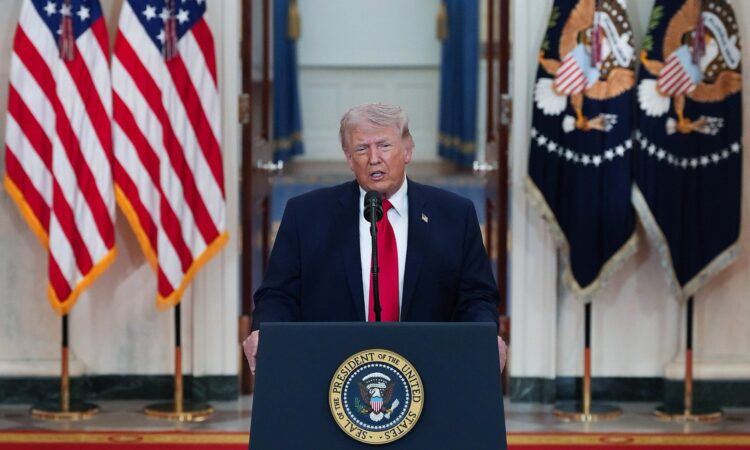
The speech raised more confusion than clarity about the war in Iran.
Americans had been waiting for their president, Donald Trump, to finally speak clearly about why the country is involved in another conflict in the Middle East. For weeks, he had only shared short comments and brief statements about his decision. This national address was expected to explain the situation and calm people’s fears.
Instead, it seemed to do the opposite.
Rather than delivering a strong and focused wartime message, the speech felt scattered and unclear. It moved from complaints to self-praise to exaggerated claims, sometimes without any clear connection. He appeared tired and low on energy, and after less than 20 minutes, many people were left feeling even more worried than before.
The speech began in a confusing way. Instead of directly explaining why the U.S. is fighting Iran, a country with over 90 million people, he talked about an unrelated operation involving Venezuela. It almost sounded like he was trying to suggest that the Iran conflict would be quick and easy. He also made a dramatic claim that Iran had suffered losses unlike anything in the history of war, ignoring the scale of past global conflicts.
Much of what he said was not new. He repeated points he had already made when the strikes on Iran first began. He correctly mentioned that Iran’s government has caused problems for the United States and other countries for many years. However, he kept shifting back to praising his own past decisions, like the killing of Qassem Soleimani and his decision to cancel the nuclear agreement made under Barack Obama. At one point, he even made a strange claim that money from U.S. banks had been completely emptied and sent to Iran, which sounded exaggerated and unclear.
The biggest question remained unanswered: why exactly is the United States fighting this war?
Trump said the goal is to stop Iran from getting nuclear weapons. Many people would agree that this is important. But he did not provide any clear evidence that Iran was close to building such weapons. Instead, it sounded like the war was launched to prevent something that might happen in the future.
Then, his own argument became even more confusing. He claimed that Iran’s nuclear program had already been destroyed in earlier strikes and buried under rubble, making it inaccessible. If that were true, it raised the question—why continue the war?
At another point, it seemed like the war might be about removing Iran’s leadership. But he denied that completely, saying regime change was not the goal. Then, almost in the same breath, he suggested that regime change had already happened because several Iranian leaders had been killed. The message felt inconsistent and unclear.
He also listed other goals, such as stopping Iran’s ability to support terrorism, destroying its navy, and eliminating its missiles. He claimed these could all be achieved within two to three weeks, but did not explain how. His only explanation was that the U.S. would strike Iran very hard.
Meanwhile, important realities were barely addressed. Iran still has influence over the Strait of Hormuz, a key global oil route. Instead of explaining how the U.S. would handle this, he suggested other countries should step in and deal with it. He also dismissed concerns about the economy, promising that everything would improve, and claimed the country was stronger than ever before.
Some of his statements could become problems later. He promised that U.S. allies, including Israel and Gulf countries, would not suffer harm, even though they already have. He also said gas prices would go down, which is uncertain in the middle of a conflict. At one point, he threatened to destroy Iran’s power infrastructure, which could lead to serious international consequences if carried out.
There were a few things he did not say, which some people saw as a small relief. He did not mention sending ground troops into Iran, and he did not attack NATO or threaten to leave the alliance, which some had expected.
Overall, the speech did not achieve its main goal of reassuring the public. Instead, it gave the impression that the situation is more complicated than expected and that the administration may not have a clear plan. The president appeared unsure and unfocused, repeating phrases and struggling to deliver a strong message.