Rachel Maddow debunks lie after lie from Donald Trump’s ‘frenetic’ State of the Union

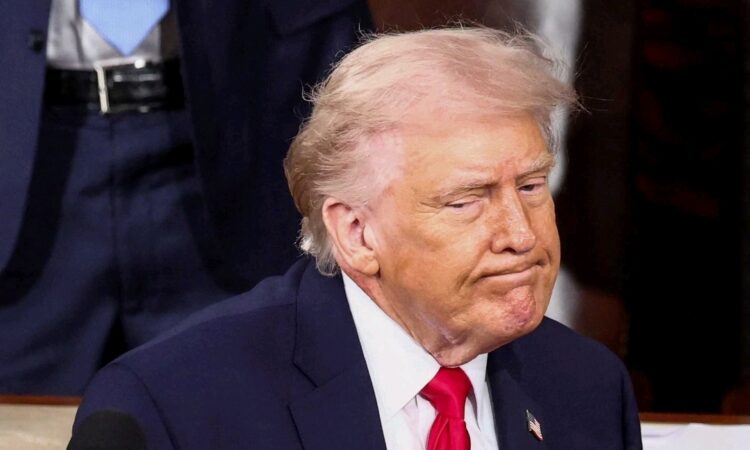
Donald Trump was seen reacting at the end of his State of the Union speech inside the House Chamber at the United States Capitol in Washington, D.C., on February 24, 2026. The speech itself quickly became the main topic of conversation, not just because of what he said, but because of how long it lasted and how forcefully he delivered it.
On MSNBC, Rachel Maddow spoke at length about the address. She tried to break down what viewers had just watched and explain why she believed many of the president’s claims, especially about the economy, were misleading or flat-out false.
One of the first things she pointed out was the length of the speech. It ran for more than one hour and 47 minutes, making it the longest State of the Union address in American history. She reminded viewers that the previous record-holder was also Trump, from the year before. So this time, he broke his own record.
Maddow said that if people at home felt like the speech dragged on, that feeling was justified. It was not just in their heads. The speech really did stretch longer than any other in modern history. She suggested that for many people, the biggest takeaway might simply be how extremely long and exhausting it felt to sit through it.
She also described the way Trump delivered the speech. At the very beginning, she said, he spoke very quickly and with a lot of excitement and intensity. He moved from one point to another without slowing down much. According to her, during this fast-paced opening, he made several bold statements about the state of the economy. She argued that many of these statements did not match the actual numbers.
For example, Trump said he had inherited the worst inflation in the history of the United States. Maddow pushed back on that claim. She explained that historically, the country experienced much worse inflation in earlier decades, especially during the 1920s and the 1980s. In her view, calling recent inflation the worst ever ignored well-known periods in American economic history.
She also challenged what he said about gas prices. Trump mentioned gas being as low as $1.85 per gallon. Maddow said that was far from the national average, which she said was closer to $2.90 per gallon. She argued that presenting such a low number gave a misleading impression about the real cost of fuel for most Americans.
When Trump talked about jobs, he described job creation under his leadership as miraculous and the best in the country’s history. Maddow responded by comparing the numbers from recent years.
She noted that in 2023 and 2024, under Joe Biden, the economy added more than 2 million jobs each year. Then she said that in 2025, under Trump, job growth was under 200,000. From her perspective, that difference was significant, and it did not support the president’s claim of record-breaking job growth.
She also addressed Trump’s broader statement that he had taken over the worst economy in U.S. history and turned it into one with the strongest growth ever. Maddow again referred to GDP numbers. She said that economic growth was 2.9 percent in 2023 and 2.8 percent in 2024 under Biden.
In 2025, under Trump, it was 2.2 percent. To her, those numbers did not show a dramatic turnaround. Instead, she suggested that growth had actually slowed compared to the previous two years.
Maddow further criticized his comments about grocery prices and inflation. Trump appeared to suggest that food prices were under control and improving.
However, she said grocery prices had risen by 2.9 percent, while overall inflation was about 2.5 percent. That meant grocery costs were increasing slightly faster than general inflation. In simple terms, she argued, families were still feeling pressure at the supermarket.
Throughout her analysis, Maddow suggested that Trump did not spend much time carefully explaining or defending these economic claims. Instead, she said, he quickly listed many positive-sounding statements in a row, especially at the start of the speech.
She described his tone as energetic and at times almost frantic. To her, it seemed like he was trying to create momentum and excitement rather than slowly walk through detailed evidence.
In the end, Maddow’s overall message was that the speech stood out for two main reasons. First, it was historically long, stretching close to two hours and breaking records.
Second, it contained a series of strong economic claims that she argued did not match the available data. She suggested that viewers might remember not only the length of the speech, but also the speed, intensity, and confidence with which those disputed claims were delivered.