Small Boat Migrants Arrive in the UK Again After Nearly Three Weeks of Bad Weather, but This Time Something Unusual About Their Journey Across the Channel Has Caught People’s Attention


Migrants have arrived in the United Kingdom after nearly three weeks without any small boats successfully crossing the English Channel. The latest arrivals came after weather conditions improved, allowing boats to make the dangerous journey from mainland Europe to Britain.
According to a report published by The Independent on Friday, October 30, 2026, a total of 263 migrants arrived in Britain on Thursday, October 29, ending a 21-day period without any recorded small boat arrivals.
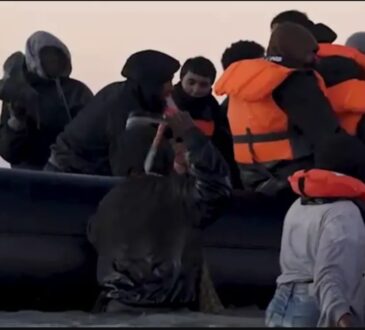
The migrants travelled across the English Channel in three small boats before being brought ashore in Dover, Kent. Several children were among those who arrived, with groups of people wearing life jackets seen coming ashore.
For almost three weeks, strong winds, rough seas and poor weather had made it difficult for small boats to cross the Channel. The conditions were considered too dangerous for many of the vessels commonly used by migrants attempting to reach Britain.
However, the situation changed when the weather improved, allowing crossings to resume after the long break.
The three-week period was the longest time Britain had gone without recording any small boat arrivals this year. The return of crossings has once again brought attention to the government’s efforts to prevent dangerous journeys across the Channel.
Figures released by the Home Office show that the latest arrivals have brought the total number of people who have reached Britain in small boats this year to 21,198.

Despite the recent arrivals, the number of migrants crossing the Channel remains considerably lower than during the same period in previous years.
By this point in 2025, approximately 36,954 people had made the journey, compared with 29,867 during the same period in 2024. This means the number of arrivals recorded so far in 2026 is substantially lower than in both years.
The latest developments have also attracted attention following reports of an unusual small boat seen leaving Belgium.
Unlike the dark-coloured inflatable boats commonly used for Channel crossings, this vessel was painted red, white and green, with a golden sun symbol resembling the Kurdish flag.
The appearance of the boat attracted attention because of its distinctive colours and design. However, it remains unclear who was responsible for painting it or whether the vessel was among those that successfully reached Britain.
The Kurdish flag is associated with Kurdish communities across parts of the Middle East, including Iraq, Turkey, Iran and Syria. Some criminal networks involved in organising Channel crossings have been linked to Iraqi Kurdish people-smuggling operations.
However, there has been no official confirmation connecting the unusual boat to any particular criminal organisation.
The reports prompted a response from Reform UK leader Nigel Farage, who criticised the continued arrival of migrants through the English Channel.
Farage expressed concern about the activities of people-smuggling gangs and suggested that boats were now departing from several locations along the European coastline, including Calais, Normandy and Belgium.
He also repeated his position that the Royal Navy should play a greater role in preventing small boats from reaching Britain.
His comments came as the government continued to face questions about its approach to immigration and the measures being taken to stop people from making dangerous journeys across the Channel.
Downing Street responded by saying that the government recognised the need for further action.
A spokesperson for the Prime Minister said officials were not aware of the specific incident involving the unusually painted boat but acknowledged that more work was needed to tackle small boat crossings.
The government maintained that it remained committed to working with international partners to disrupt criminal gangs involved in arranging the journeys.
The Home Office also defended the progress made so far, pointing to the reduction in Channel arrivals compared with previous years.
According to the department, Britain recently recorded its lowest number of summer small boat arrivals since 2020.
Officials said cooperation with other countries had helped prevent more than 50,000 attempted crossings since the election.
The Home Office also reported that around 1,100 boats and engines had been seized as part of efforts to prevent people-smuggling gangs from operating.
These measures form part of the government’s wider strategy to reduce dangerous crossings and prevent criminal groups from making money by transporting people across the Channel.
Despite these efforts, the latest arrivals show that crossings can resume quickly whenever weather conditions become more favourable.
The English Channel remains one of the world’s busiest shipping routes, with large commercial vessels regularly travelling through its waters.
Crossing the Channel in a small inflatable boat carries serious risks, particularly when vessels are overcrowded or unsuitable for travelling long distances at sea.
Passengers may face dangerous currents, sudden changes in weather and the possibility of their boats becoming damaged or taking on water.
Many people who make the journey intend to claim asylum in Britain, although their individual circumstances vary. Those who arrive are subject to immigration procedures, and any asylum claims must be considered under the relevant rules.
The latest arrivals also came as reports suggested that further crossings could be taking place.
On Friday morning, at least two additional boats were reportedly seen leaving the French coast, raising the possibility of more migrants reaching Britain.
However, it was not immediately clear how many people were travelling in those boats or whether they would complete the journey.
The developments have renewed attention on the challenges facing the government as it attempts to reduce Channel crossings while ensuring that people arriving in Britain are dealt with through the appropriate immigration procedures.
Although the number of arrivals this year remains lower than in previous years, the return of small boats after three weeks of poor weather suggests that the situation could change whenever conditions at sea improve.
With the colder months approaching, weather conditions may make crossings more difficult. However, the latest arrivals demonstrate that people are still prepared to attempt the journey when an opportunity arises.
The government continues to insist that cooperation with European authorities and action against people-smuggling gangs are essential to reducing crossings.
For now, the arrival of migrants after a three-week break has brought the issue back into focus, with further attention likely to fall on whether the government can maintain the reduction in crossings recorded so far this year.