“I Came to England to Work, Build a Better Life and Support My Family, But What I Have Been Experiencing Since I Arrived Has Left Me Frightened. I Never Expected This to Happen in England.”

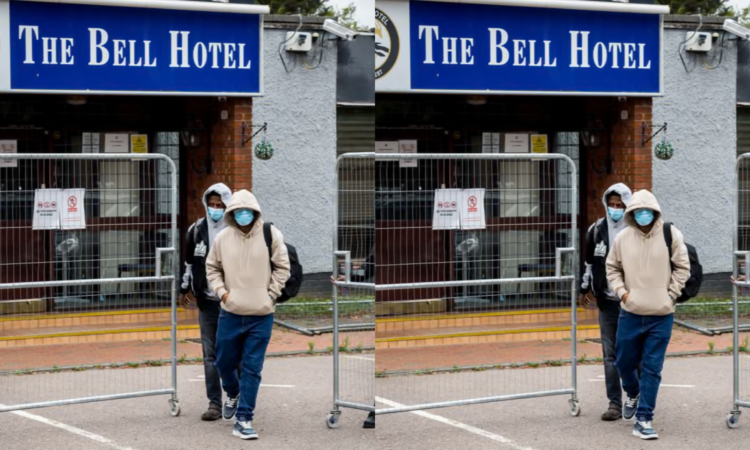
An asylum seeker living in a hotel in Essex has spoken about the terrible treatment he says he has received from some local people since protests began outside the building.
The man, 24-year-old Khador Mohamed from Somalia, said he came to Britain hoping to find safety and an opportunity to rebuild his life. However, he said his experience has been very different from what he expected.
Mohamed is one of several asylum seekers staying at the Bell Hotel in Epping, Essex, which has become the centre of protests over the government’s decision to use hotels to accommodate people seeking asylum.
The protests began after another asylum seeker staying at the hotel was charged with sexually assaulting a 14-year-old girl. The case caused anger among local residents, with protesters gathering outside the building to demand its closure.
Some demonstrations became violent, and police were called to deal with the situation.
Mohamed said life inside the hotel became very difficult after the protests started. According to him, residents were sometimes told to remain inside their rooms for their own safety.
Even when they were allowed to go outside, he claimed they faced insults and abuse from some members of the public.
“People call you scumbags sometimes and they throw cans of soda at you,” he said.
Mohamed explained that he never imagined he would experience such treatment after arriving in England.
“I wasn’t expecting this in England. I thought it would be friendlier,” he said.
He believes the attitude of some local people changed completely after the sexual assault charge against the other hotel resident.
Before the incident, Mohamed said asylum seekers could walk around without attracting much attention. But afterwards, he felt that people began looking at everyone staying at the hotel as though they were criminals.
“Now we’re seen as criminals. Before that we were just normal people,” he explained.
He recalled one particularly painful experience when a woman saw him walking along the street and immediately moved her children behind her, apparently trying to protect them from him.
Mohamed said the woman’s reaction made him feel deeply hurt because he had done nothing to threaten her or her children.
“It was a painful thing to happen to me – now we’re seen as rapist, paedophiles and thieves,” he said.
Although he understood why the allegations had caused anger, Mohamed insisted that asylum seekers should not all be judged because of the actions of one person.
“I am sorry for what happened, but there is nothing much I can do. We are not all the same,” he said.
The situation became even more uncertain after the High Court ruled on Tuesday, 19 August 2025, that the Bell Hotel could no longer be used to house asylum seekers because of a breach of planning rules.
The decision was welcomed by some people who had been campaigning against the hotel’s use as asylum accommodation.
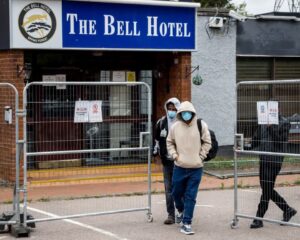
On Wednesday, drivers passing the hotel sounded their horns, apparently celebrating the ruling.
One driver displayed a Union Jack flag from a black Audi, while another shouted abusive comments towards the people staying inside.
A man driving a van reportedly shouted, “Shoot the lot of ’em.”
Another driver shouted, “Goodbye, goodbye,” before adding, “We pay our taxes.”
For Mohamed and other asylum seekers, however, the court decision created another serious problem.
They were left wondering where they would be taken and whether they would have somewhere safe to sleep.
Mohamed said he had received very little information about what would happen next.
“They just keep us in the dark. And if you ask them what’s going to happen they just ignore you,” he said.
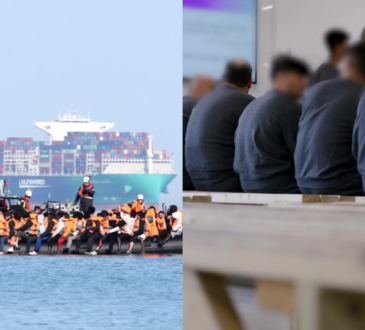
Speaking about how he reached Britain, Mohamed explained that he arrived earlier in 2025 after crossing the English Channel in a small boat carrying around 60 people.
He said he paid people smugglers €1,000, approximately £865, to arrange the dangerous journey.
Mohamed admitted that he had entered Britain illegally, but insisted that he had not committed any other crime.
“The only offence I committed was coming to this country illegally. I had to do it. I had no any other option but I’ve not done any other crime,” he said.
He also explained that he understood why some British residents were unhappy about taxpayers’ money being spent on accommodation and food for asylum seekers.
However, he said he did not want to depend on free accommodation or government support.
Instead, he wanted the authorities to make a decision on his asylum application so that he could work legally and support himself.
“I don’t need a free house, or free food. I just need my asylum application to be accepted. Then I can work on my own and I can earn my own food and my rent,” he said.
Mohamed explained that he had worked before leaving his home country.
In Somalia, he worked as a tuk-tuk driver, while in Austria he had worked as a dishwasher.
He said he was willing to accept almost any honest job in Britain, even if it involved cleaning toilets.
“I’ll do anything to earn money, even if it’s cleaning toilets, I don’t mind. I don’t have the luxury to choose,” he said.
According to him, working would allow him to pay his own bills and stop depending on the government.
He also believed that being able to support himself might reduce some of the anger directed towards asylum seekers.
“Anything, as long as British people are not mad at me sitting in hotel getting stuff for free. That’s a reasonable thing to get mad about,” he added.
Meanwhile, another asylum seeker staying at the Bell Hotel also expressed concern about the uncertainty surrounding their future.
The 29-year-old man from Eritrea, identified by the false name Yonas to protect his identity, said he had only been living at the hotel for two weeks.
He explained that nobody had told him where he would be moved following the court ruling.
“We have no information from the hotel. Nobody has said anything. I’m new here. I’ve been here two weeks and I don’t know anything,” he said.
Yonas said he also arrived in Britain by crossing the English Channel from France.
He claimed he paid smugglers €1,700 to make the journey.
Like Mohamed, he said he came to Britain believing it was a country where people could seek protection and enjoy freedom.
However, he said his experience had left him disappointed.
“Britain is a democracy. That is why I come to ask to be a refugee. But there’s no freedom here in the UK. It’s like jail. I don’t have anything here,” he said.
Yonas explained that he had previously served in the Eritrean army and believed he could find work in Britain as a mechanic or driver.
But he said he could not work because he did not have the necessary documents.
“I would like to work but I don’t have documents,” he explained.
The court ruling also created wider concerns about the government’s use of hotels to accommodate asylum seekers across England.
The owner of the Bell Hotel, Somani Hotels Ltd, was given until 12 September 2025 to comply with the decision.
At the time, other local councils were considering similar legal action to stop hotels in their areas from being used for asylum accommodation.
The situation raised questions about what would happen to approximately 30,000 asylum seekers who were being accommodated in hotels across the country.
One of the councils considering legal action was Broxbourne Council in Hertfordshire.
The council announced plans to challenge the use of a hotel in its area to accommodate asylum seekers.
The Delta Marriott Hotel in the town had also become the location of regular protests.
For three consecutive Fridays, demonstrators had gathered outside the hotel to express their anger about asylum seekers being accommodated in the community.
The hotel was one of six in Hertfordshire being used to house asylum seekers and was accommodating families with children.
Some parents said the protests had left their children frightened.
One father explained that his family became scared whenever protesters arrived outside the building.
“Our children were terrified when the protesters came every Friday,” he said.
He explained that the family tried to keep their children away from the windows during demonstrations because they feared what might happen.
The father said he had heard that the council wanted the hotel closed but had received no information about where his family would be taken.
“Will the Home Office put us in the street?” he asked.
He also explained that his family had not left their home country simply because they wanted to live in Britain.
According to him, they previously had a comfortable home and a successful business but were forced to leave because they feared for their lives.
“Like other asylum seekers we did not leave our country willingly – we had a nice house and a good business there. We only left because our lives were in danger,” he said.
The father believed the government could reduce the cost of asylum accommodation by allowing people waiting for decisions on their claims to work.
He argued that many asylum seekers would prefer to earn their own money, rent accommodation and buy food rather than depend on public support.
“The Home Office could solve this by allowing us to work while we are waiting for our claims to be processed then we could provide our own accommodation and buy our own food,” he said.
He also expressed disappointment about the hostility his family had experienced.
“We know the UK is a civilised country but we have seen racism here. Racism is killing the world. We are here for peace,” he added.
Another asylum seeker who had been staying at the Hertfordshire hotel for more than two years said he was worried about losing the only place he could currently call home.
He explained that some protesters had approached the windows of residents’ bedrooms and filmed them.
According to him, this made the people living inside feel uncomfortable and unsafe.
He said he had also recorded some of the protesters to keep evidence of what was happening.
“This is my only home,” he said.
He questioned how British residents would feel if strangers came to their homes and started recording them through their windows.
The situation highlighted growing tensions surrounding the government’s use of hotels to house asylum seekers while their applications are being processed.
Many local residents were concerned about safety, public spending and the effect of asylum accommodation on their communities.
At the same time, asylum seekers interviewed at the hotels said they were frightened, uncertain about their future and frustrated that they were unable to work and support themselves.
For Mohamed, the most painful part of his experience was being treated as though he had committed a serious crime simply because he was an asylum seeker staying at the hotel.
He insisted that he wanted nothing more than an opportunity to work, earn money and live peacefully without depending on public support.
But following the court decision and the protests outside the Bell Hotel, he and the other residents were left waiting to discover where they would be moved next.