854 Migrants Rescued From Seven Small Boats After a Dangerous Journey, But What Happened After They Arrived Has Left Authorities Facing a Difficult Situation

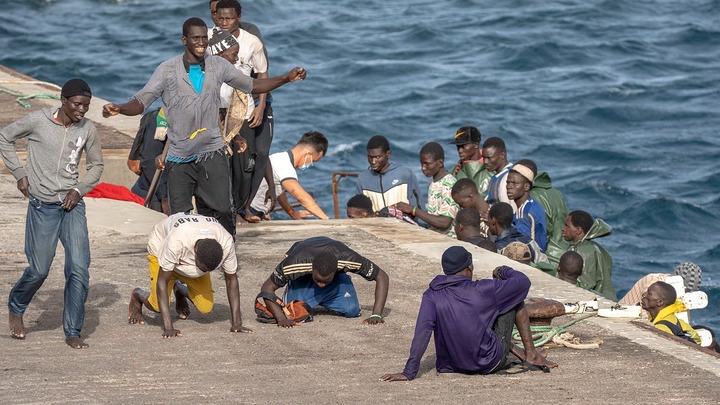
Spain’s Maritime Rescue Service has rescued 854 migrants travelling in seven small fishing boats near the Canary Island of El Hierro. The rescue operation began in the early hours of Friday morning, with all seven boats brought safely to the port of La Restinga.
The large number of arrivals has placed extra pressure on migrant reception centres on the island, forcing Spanish authorities to arrange transfers to Tenerife.
Officials confirmed that 350 migrants were moved to Tenerife on Friday morning using a scheduled ferry service. Another 350 were expected to be transferred later that afternoon to reduce overcrowding at reception facilities on El Hierro.
Several migrants needed medical treatment after arriving on the island. Nine people were still receiving treatment at Nuestra Señora de los Reyes Hospital after arriving on different boats in recent days. They were being treated for various health problems.
Three rescue vessels, named Salvamar Navia, Diphda and Mizar, were involved in Friday’s operation.
The first migrant boat was discovered about four miles from La Restinga harbour. Rescue workers escorted it to the port, where it arrived at around 1 am carrying 134 people.
More boats continued to arrive throughout the morning.
At around 4:45 am, a second boat reached the harbour with 174 migrants on board. Just 15 minutes later, another vessel arrived carrying 166 people.
The largest boat arrived at approximately 8:30 am with 235 migrants. Shortly afterwards, at around 9 am, a fifth boat brought another 54 people to the island.
A sixth vessel carrying 39 migrants reached the harbour at approximately 10:15 am, while the final boat arrived at 12:30 pm with 52 people on board.
Emergency services said the migrants on the seven boats were from sub-Saharan Africa. Most were men, although women and children were also among those rescued.
Authorities have not yet confirmed which countries the migrants originally came from or where their boats began the dangerous journey across the sea.
Several emergency organisations were involved in helping the migrants after their arrival.
These included the Spanish Red Cross, the Canary Islands Emergency Service, port security workers, the Civil Guard and the National Police.
Medical teams checked the migrants and provided immediate assistance to those who needed help.
After receiving medical attention, the migrants were taken to the Temporary Foreign Nationals Reception Centre in San Andrés, located in the municipality of Valverde.
At the centre, they are expected to receive humanitarian support from the organisation Corazón Naranja-Ebrima Sonko.
They will remain under police supervision while arrangements are made to move them to other reception facilities outside El Hierro.
Meanwhile, more migrants have also been arriving on other islands in the Canary Islands.
On Thursday night, at around 10 pm, Spanish rescue workers brought another group of migrants to Arguineguín, on the southern coast of Gran Canaria.
The exact number of people involved in that rescue had not been confirmed.
Lanzarote also recorded two separate migrant arrivals between Thursday night and Friday morning.
The first boat carried 27 men from North Africa, while a second group of 61 migrants arrived later.
The latest arrivals show that migrants are continuing to make dangerous sea journeys towards Spain’s Canary Islands, with rescue teams responding to several boats within a short period.
The situation has also increased pressure on local authorities, who must provide emergency medical care, temporary accommodation and support for those arriving.
With hundreds of migrants being moved from El Hierro to Tenerife, Spanish officials are working to make space in reception centres while preparing to deal with further arrivals.