Karoline Leavitt Gets So Caught Up Going After an Enemy She Humiliates Herself and Blows Up the One Claim Donald Trump Needed Everyone to Believe

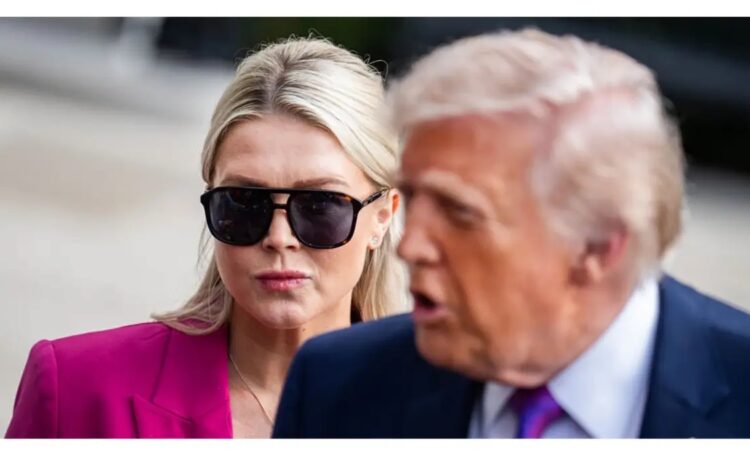
President Donald Trump has developed a pattern in the way he talks about major national or international crises. He often makes big, dramatic statements that are unclear or even contradict each other. Afterward, members of his administration, especially his press secretary Karoline Leavitt, are left trying to explain what he meant.
Leavitt has become used to stepping in and clarifying the president’s comments. But sometimes those attempts to fix the message end up creating even more confusion. That is exactly what happened this week after a heated exchange involving a report about a possible Iranian threat to the United States.
The situation began when ABC News reported on an FBI bulletin that had been sent to law enforcement agencies in California. According to the report, intelligence suggested that Iran may have considered launching a surprise drone attack from a ship somewhere offshore, potentially targeting parts of the U.S. West Coast.
However, the bulletin also clearly stated that the information was unverified. The intelligence was based on a tip that had not been confirmed, and it did not provide specific details about when such an attack might happen or what targets might be involved.
After the story was published, Karoline Leavitt quickly responded on social media. She accused ABC News of spreading false information and demanded that the network retract the story. In her post, she said the report was based on a single email that mentioned an unverified intelligence tip and argued that the news outlet had left out important context.
Leavitt wrote that ABC News had intentionally alarmed the American public by publishing the story. She emphasized that the tip described in the FBI message had not been confirmed and insisted the network had misrepresented the situation.
But the most controversial part of her statement came when she added a very direct claim. She wrote that there was no threat from Iran to the U.S. homeland and that such a threat had never existed.
That line quickly spread across social media and sparked intense criticism. Many people pointed out that President Trump had repeatedly justified the military strikes against Iran by saying the country posed an imminent threat to Americans.
Trump had previously told reporters that Iran was preparing to attack the United States and that action had to be taken to stop it. At one point he said that Iran would have attacked within a week if the U.S. had not acted first.
The president had also recently claimed that Iranian sleeper cells were inside the United States and that American authorities were monitoring them. Because of those earlier statements, critics quickly noticed what they saw as a contradiction between Trump’s warnings and Leavitt’s claim that no threat existed.
Social media users began posting screenshots of her statement and questioning the administration’s explanation for the war. Some people asked why the United States had launched military strikes if there was no real threat. Others suggested that her message accidentally undermined the administration’s own justification for the conflict.
ABC News later updated its report to make it clearer that the intelligence described in the FBI bulletin was unverified. Still, the controversy continued because of the strong language Leavitt used in her response.
Supporters of the administration tried to defend her statement. They argued that she was only referring to the specific drone attack mentioned in the FBI alert and not denying that Iran might pose other types of threats.
However, critics said that explanation did not fully resolve the confusion. Some pointed out that if the FBI had warned local authorities about a possible attack, dismissing the threat entirely seemed inconsistent.
The debate also reminded many observers of another recent moment when Leavitt tried to clarify one of Trump’s statements. Earlier, Trump had demanded what he called Iran’s “unconditional surrender,” a phrase normally used to describe the total defeat of a country in war.
When reporters asked about that comment, Leavitt attempted to explain that Trump did not necessarily mean Iran would formally surrender in the traditional sense. Instead, she suggested the phrase meant that the United States would continue military operations until Iran no longer posed a threat.
That explanation also triggered confusion and criticism online, with many people saying the phrase “unconditional surrender” has a very specific meaning in international conflicts.
These repeated moments have led critics to argue that the administration’s message about the war in Iran often shifts depending on the situation. In their view, Trump frequently makes bold claims while Leavitt is left trying to translate those statements into a more detailed policy explanation.
As the debate continues, the situation highlights how complicated and politically sensitive public communication can become during times of military conflict. Even a single sentence from a government official can spark a major reaction if it appears to contradict the larger narrative surrounding a war.