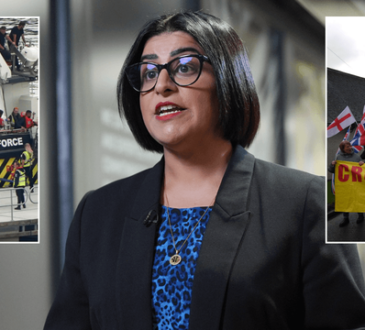
Home Secretary Shabana Mahmood Could Lose the Seat She Has Held for 16 Years After a Major Political Change in Birmingham and a Growing Concern She Didn’t Expect

Shabana Mahmood could be at serious risk of losing the Birmingham Ladywood seat she has held since 2010 at the next General Election. Political experts say growing anger over Gaza is changing the way many people in the constituency plan to vote, with the Green Party and pro-Gaza independent candidates gaining support.
At the same time, Ms Mahmood is facing pressure over her proposed changes to the asylum and immigration system. Trade unions, Labour MPs and even some members of the Government have criticised the plans and called for them to be changed.
However, political experts believe the biggest danger to her career may come from Birmingham Ladywood, rather than Westminster. The constituency was once considered a very safe Labour seat, but it has become far more politically divided in recent years.
One resident said Birmingham was now deeply split and that this was creating a major challenge for Ms Mahmood. The person claimed that the conflict in Gaza was one of the main reasons more voters were moving towards the Green Party.
The resident said many people wanted politicians who would clearly defend their beliefs and values. In their view, voters did not feel that Ms Mahmood was doing enough on the issues that mattered to them.
Labour controlled the area comfortably for decades, and Ms Mahmood once won elections with a very large majority. But that support has fallen sharply. Some forecasts now suggest that the Greens could take Birmingham Ladywood at the next election.
There are concerns that Ms Mahmood could face a campaign similar to the one seen during the Gorton and Denton by-election. In that contest, Green Party leader Zack Polanski focused heavily on the war in Gaza while campaigning for the party’s candidate, Hannah Spencer.
Ms Spencer was seen holding signs accusing Reform UK of Islamophobia, and she also wore a keffiyeh during the campaign. The keffiyeh is a traditional scarf worn in many parts of the Middle East and is often used as a symbol of support for Palestinians.
A senior Government minister accused the Greens at the time of deliberately making Gaza a central election issue and increasing anger among voters. The minister said Labour had badly underestimated how different and aggressive the Green Party’s campaign had become.
The campaign also attracted controversy after Jewish Labour peer Lord Katz criticised a Green Party leaflet written in Urdu. The leaflet reportedly told voters that Labour should be punished over its handling of Gaza.
Jex Parkin, Reform UK’s opposition leader on Birmingham City Council, said the political divisions in Birmingham should be seen as a warning for the rest of the country.
He described Birmingham as a fragmented city with a divided council and a deeply divided society. He said many groups now had different political aims, beliefs and ideas about how people should live together.
According to Mr Parkin, problems can grow when people are no longer united by common goals or a shared purpose.
Birmingham’s local elections showed how much the city’s politics had changed. Labour, which once dominated the council, fell into fourth place after losing control.
Reform UK won the largest number of seats, taking more than 22 wards. However, it did not secure an overall majority. The Liberal Democrats, who won 12 seats, later formed an administration with pro-Gaza independents and the Green Party, which secured 19 seats.
Ms Mahmood described the result as a devastating night for Labour. She agreed with calls for the party to improve and rebuild the trust it had lost among voters.
Her own election results also show how much her position has weakened. In 2017, she won Birmingham Ladywood with a majority of 28,714 votes. At the 2024 General Election, however, her majority fell to fewer than 3,500.
Martin Baxter, the chief executive of Electoral Calculus, said it was still difficult to say with certainty that the Greens would win the seat in 2029. He explained that Birmingham Ladywood has unusual voting patterns that make it harder to predict than many other constituencies.
Around 53 per cent of the constituency’s population is Muslim, making it one of the parliamentary seats with the highest proportion of Muslim residents in the country. Support for pro-Gaza independent candidates has also increased significantly.
Following the October 7 attacks in 2023, Ayoub Khan, who was then a Liberal Democrat councillor in Birmingham, called on the council to recognise an increase in anti-Muslim hatred.
He also demanded the creation of a programme to provide homes for Palestinian refugees, similar to the Homes for Ukraine scheme.
Mr Khan later became the independent MP for Birmingham Perry Barr after the 2024 General Election. He also criticised former Home Secretary Suella Braverman for saying that the phrase “from the river to the sea” was antisemitic, although he later apologised for his comments.
In Birmingham Ladywood during the 2024 General Election, pro-Gaza independent candidate Akhmed Yakoob received 33 per cent of the vote. Ms Mahmood won with 42 per cent, leaving only a relatively small gap between them.
Mr Baxter said another Muslim independent candidate could stand at the next election. He added that the Green Party was also making a strong effort to attract Muslim voters.
A poll carried out before the local elections found that more than half of Muslim voters were prepared to support pro-Gaza independent candidates to prevent Labour from winning.
Research by Policy Exchange also suggested that Labour’s support among Muslim voters had fallen from a historic level of around 80 per cent to just 33 per cent. Nearly half of those questioned said they would consider voting for Zack Polanski’s Green Party for similar reasons.
Prime Minister Andy Burnham has also attempted to rebuild Labour’s relationship with Muslim voters and members of the party’s soft-left wing who had become disappointed with its previous leadership.
Shortly before entering Downing Street, Mr Burnham apologised for Labour’s initial response to Israel’s military operation in Gaza. He admitted that the party had not handled the matter properly and promised that it would do better under his leadership.
Mr Baxter said these efforts could influence how Muslim voters in Ladywood respond at the next election, making the final result even harder to forecast.
Electoral Calculus currently predicts that the Greens could receive around 37.2 per cent of the vote in Birmingham Ladywood. Ms Mahmood is forecast to finish second with about 24.9 per cent. However, Mr Baxter warned that this estimate had a larger margin of error than usual because of the constituency’s unusual political situation.
Ms Mahmood is also facing problems in Westminster after announcing major reforms to the UK’s asylum and immigration system.
Under the proposed changes, some migrant workers could be required to wait 10 years before qualifying for permanent settlement, instead of the current five years. Refugees could have to wait as long as 20 years.
The proposals have led to calls for care workers to be given special protection. Critics argue that the social care system depends heavily on overseas employees and could lose experienced staff if the rules become stricter.
Mike Tapp, who served as a junior Home Office minister, publicly argued that care workers who came to Britain legally, followed the rules and contributed to the country should not be forced to wait longer for settlement.
His comments reportedly caused a dispute inside the Government because his article had not been authorised. Questions were raised about whether he had broken the rules requiring ministers to publicly support agreed Government policy.
Ms Mahmood was reportedly interested in removing him from his position, but Downing Street blocked any immediate attempt to dismiss him. Mr Tapp was later removed from the Government during Mr Burnham’s first days in Downing Street.
There were also questions about whether Mr Burnham would keep Ms Mahmood as Home Secretary because many politicians on Labour’s left strongly opposed the direction of her immigration policies.
Unison, Labour’s largest trade-union supporter, has now increased the pressure on Ms Mahmood. The union represents more than 1.3 million workers and has described the proposed immigration rules as cruel and unnecessary.
Unison general secretary Andrea Egan said the social care system was already under enormous pressure, with tens of thousands of jobs unfilled.
She said the sector had become dependent on overseas workers who were willing to perform essential and demanding jobs. In her view, the Home Secretary’s proposals could make those workers feel unwelcome and encourage experienced employees to leave Britain.
Ms Egan said the Government must treat care workers fairly if it is serious about improving the sector. She called for the proposed changes to be abandoned.
Migration expert Rob Bates believes Ms Mahmood may eventually weaken the reforms, which were introduced to Parliament through the Immigration and Asylum Bill in June.
Angela Rayner also criticised the plans from the backbenches in April. She described the idea of making it more difficult for migrants already living in Britain to settle permanently as un-British.
Ms Rayner has since returned to the Government as housing minister and repeated her concerns. She said it would be unfair to invite people to Britain under a particular set of rules and then change those rules after they had arrived and begun contributing to the country.
She also said Britain needed to make social care a more attractive career for young people. Ms Rayner explained that workers should be given a clear career path, allowing them to begin in care and later progress into other positions in social care or the health service.
The Government has held a public consultation on whether transitional protection should be provided for people already living in Britain who have not yet received settled status.
Mr Bates believes the Government may use the consultation results to decide whether to continue with the stricter rules. He claimed that unions, left-wing organisations and community groups had strongly influenced the consultation and were likely to oppose extending the settlement period.
He also said it would be important to see how the immigration proposals connect with the Government’s expected plans for the social care sector.
A Government spokesperson confirmed that around 200,000 responses to the consultation were being reviewed. The spokesperson said no final decision had been made and that details of the new Earned Settlement system would be announced in the autumn.