Donald Trump Readies His Revenge for a Democratic House, Setting Up a Brutal Showdown with the Black Leader He Called ‘Low IQ’

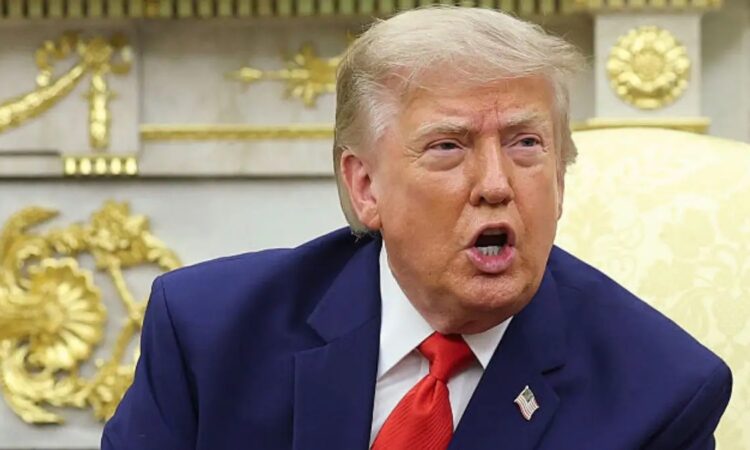
President Donald Trump has warned that he could use his presidential veto powers to block laws passed by Congress if Republicans lose control of the House of Representatives or the Senate in the midterm elections.
Speaking during an interview with Fox News on Sunday, Trump made it clear that he is prepared to take a tough approach if Democrats gain control of Congress. He said he would be willing to reject bills sent to his desk until Democrats agreed to negotiate with him.
Trump even gave himself a new nickname, saying he could become “Mr. Veto” if Republicans fail to maintain their control of Congress.
“Well, if that happens, I guess I’ll become Mr. Veto,” Trump said, explaining that he believes Democrats would eventually have no choice but to sit down with him and reach an agreement.
The president pointed out that he had faced a similar situation during his first term in office, when Republicans lost control of the House of Representatives following the 2018 midterm elections.
According to Trump, having an opposition party controlling Congress would not necessarily stop him from pursuing his political plans. Instead, he believes his power to reject legislation would give him an advantage during negotiations.
He explained that Democrats could continue sending bills to the White House, but he would reject them until both sides found common ground.
Trump suggested that after a month or two of having their proposals rejected, Democratic leaders might eventually approach him to discuss possible agreements.
However, he also expressed hope that Republicans would perform well enough in the elections to avoid such a situation.
His comments quickly attracted criticism on social media, where some people accused him of putting political battles ahead of the needs of ordinary Americans.
One social media user argued that Trump’s approach could create serious problems for the country, especially if important laws and government decisions become caught up in disagreements between the White House and Congress.
The person suggested that rather than threatening to block legislation, a president should be willing to work with lawmakers from both parties to find solutions that benefit Americans.
Another commenter suggested that Trump’s remarks showed he was already preparing himself for the possibility of Republicans losing control of Congress.
Others questioned whether his proposed approach was about helping the country or simply getting back at political opponents.
Despite the criticism, the American Constitution gives the president the power to reject legislation passed by Congress. However, that power is not unlimited.
If a president vetoes a bill, Congress can still make it law by securing a two-thirds majority in both the House of Representatives and the Senate. Achieving that level of support can be difficult, particularly when lawmakers are deeply divided along party lines.
Meanwhile, the possibility of Democrats winning control of the House could create another major political challenge for Trump.
If Democrats secure a majority, House Democratic leader Hakeem Jeffries could become the next Speaker of the House, making him the first Black American to hold that position.
Such an outcome could lead to further disagreements between Trump and Jeffries, who have already exchanged strong words over several political issues.
One of their biggest disagreements has involved the American military operation against Iran.
Jeffries strongly criticised Trump’s decision to launch military strikes against Tehran earlier this year, describing the conflict as a war the president had chosen to pursue.
He also questioned the decision to begin the military operation without congressional approval.
Trump responded angrily to the criticism, attacking Jeffries personally and calling him a “Traitor Democrat” and a “Low IQ person.”
Jeffries refused to remain silent and challenged the president to a public debate.
He said he would be willing to face Trump in the Oval Office, in front of television cameras, to discuss their differences and allow Americans to judge their arguments.
Jeffries also expressed confidence that he would perform better than Trump in such a debate.
The latest disagreement comes at a difficult political moment for the president, with new opinion polls suggesting that many Americans are unhappy with his performance.
An NBC News survey released shortly before the midterm elections found that 60 percent of respondents disapproved of the way Trump was handling his job as president, while 40 percent approved.
The findings suggest that the president is facing growing public dissatisfaction as voters prepare to decide which party should control Congress.
The poll also found that nearly two-thirds of respondents wanted Trump to change his approach to governing.
Half of those surveyed said they wanted a major change in the direction of his administration.
Economic concerns also appeared to be playing an important role in public opinion.
According to the survey, 51 percent of respondents were dissatisfied with their financial situation, compared with 49 percent who said they were satisfied.
The findings highlight the financial pressure many Americans say they are experiencing and suggest that economic concerns could influence how people vote.
For Trump, the midterm elections could determine how much freedom he has to push forward with his political plans during the remaining years of his presidency.
If Republicans maintain control of Congress, the president may find it easier to secure support for his policies and legislative proposals.
However, if Democrats gain control of one or both chambers, Trump could face stronger opposition, more investigations and greater difficulty getting his proposals approved.
His warning about becoming “Mr. Veto” suggests that he is already considering how to deal with such an outcome.
While Trump believes his veto powers could force Democrats into negotiations, critics fear that repeated political disagreements could delay important decisions affecting millions of Americans.
With the country divided over the economy, immigration, foreign policy and other major issues, the election results could shape the relationship between the White House and Congress for the next two years.
For now, Trump is hoping Republicans can hold on to their congressional majorities, but his latest comments make clear that he is prepared for a political fight if voters deliver a different result.