Donald Trump Offers to Teach Obama a Lesson, Then Doubles Down with a Line That Lands Very Differently

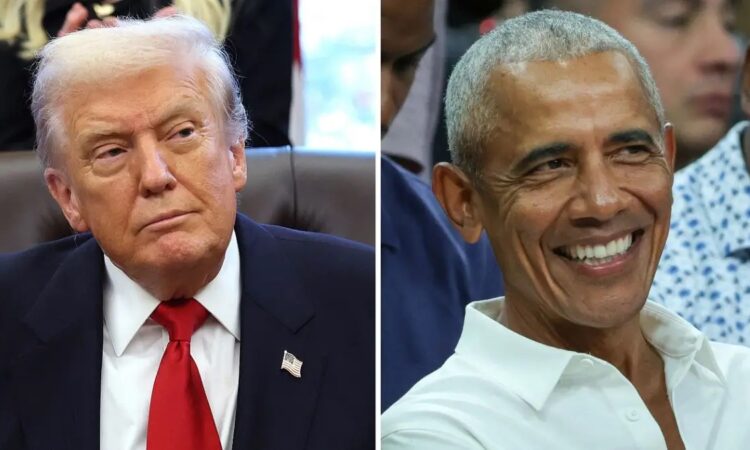
President Donald Trump has once again taken aim at former President Barack Obama after the former American leader made jokes about his expensive changes to the White House. What started as a humorous comment from Obama has now turned into another heated exchange between the two political rivals, with Trump’s latest response attracting criticism on social media.
Speaking during a campaign rally in Iowa on Sunday, Trump appeared unhappy with Obama’s recent comments about the renovations taking place at the White House. Rather than ignoring the jokes, Trump defended his decision to make changes to the historic building and suggested that Obama needed to learn something about keeping places clean.
The president told supporters that the White House should always look beautiful, properly maintained and free from damage because it represents the United States and its people.
Trump specifically mentioned broken windows, damaged decorations and other parts of the building that he believed needed attention.
“Barack Hussein Obama said, ‘Why is Trump spending so much time fixing up the White House?’ Because the White House has to be pristine. It has to be perfect,” Trump told the crowd.
He continued by explaining that the building should not have damaged exterior decorations or broken windows at its main entrance.
However, it was what Trump said next that attracted the most attention.
“I’ll teach that sometime, cleanliness. I’ll teach you cleanliness,” Trump said, directing his words towards Obama.
The statement quickly became a talking point online, with some people accusing Trump of using language that carried racist undertones. Critics argued that his decision to lecture America’s first Black president about cleanliness was offensive and reflected a wider pattern of remarks they considered disrespectful towards Black communities.
Others viewed the exchange as another example of the personal rivalry between the two men, who have frequently criticised each other over the years.
The latest disagreement began about a week earlier when Obama appeared at a political event in Ohio to support Democratic candidates.
During his speech, Obama entertained the audience by making jokes about Trump’s growing interest in changing the appearance of the White House.
Obama suggested that Trump appeared to be spending so much time thinking about renovations that he might be better suited to working on a television programme about home improvement.
“I don’t know if you noticed, but he seems very focused on home renovations. He should be on HGTV!” Obama joked as supporters laughed.
He then mentioned several changes associated with Trump’s plans for the presidential residence, including the construction of a large ballroom, alterations to the Rose Garden and the use of gold decorations inside the building.
Obama questioned why Trump seemed so interested in adding gold to different parts of the White House, joking that the president always appeared to want more of it.
The former president then made another remark that attracted loud laughter from the audience.
“He’s got the White House looking like Saddam Hussein opened a Cheesecake Factory!” Obama said.
The comparison was intended to make fun of the expensive and highly decorative appearance Obama believed Trump was creating.
Although the audience appeared to enjoy the jokes, Trump’s later comments in Iowa showed that he was prepared to respond publicly.
The exchange has once again brought attention to the difficult relationship between the two former political opponents.
Trump has repeatedly criticised Obama throughout his political career, while Obama has also spoken openly against Trump’s leadership style, political decisions and approach to government.
Their disagreements have often extended beyond government policies into personal remarks, public speeches and social media exchanges.
Following Trump’s comments about cleanliness, several social media users expressed anger and accused him of deliberately choosing words that could be interpreted as insulting towards Black Americans.
One person described the statement as racist and also criticised members of the audience who applauded.
Another questioned why Trump had chosen cleanliness as the subject of his response, suggesting that the remark was not simply about maintaining the White House.
A different commenter argued that the meaning behind Trump’s words was clear, even though the president had not directly referred to Obama’s race.
However, the remarks themselves did not establish Trump’s intention, and the accusations reflected how critics interpreted his choice of words.
The controversy has also revived discussions about Trump’s previous comments concerning predominantly Black communities, immigrant neighbourhoods and countries in Africa.
During his political career, Trump has faced criticism for describing certain American cities and neighbourhoods as dirty, dangerous or affected by rats and other problems.
His past reported remarks about African countries and other nations with predominantly Black populations have also attracted widespread condemnation.
Critics say these statements have contributed to concerns about how Trump discusses race and immigration, while his supporters have often defended his language as criticism of poor living conditions, government failures or political leadership rather than race.
The latest disagreement is not the first time Trump has attracted controversy involving Obama.
Earlier this year, Trump faced criticism after sharing an image mocking the Barack Obama Presidential Center in Chicago.
The image appeared to show the building surrounded by rubbish and a homeless encampment, accompanied by a message suggesting that the site would deteriorate over time.
The post was widely interpreted as another personal attack on Obama’s presidential legacy.
The Presidential Center, a major project dedicated to Obama’s life, presidency and public service, has itself been the subject of political debate, with supporters celebrating its cultural importance and critics questioning aspects of its development and cost.
Another controversy emerged in February when a video shared on Trump’s social media account included an AI-generated depiction of Barack and Michelle Obama as apes.
The imagery attracted strong criticism, including from some Republican politicians, because of the long history of racist comparisons involving Black people.
The post was subsequently removed, but the incident continued to generate anger and debate.
Against that background, Trump’s latest comments about teaching Obama cleanliness have received particular attention.
For some observers, the disagreement is simply another example of two powerful political figures exchanging insults in front of their supporters.
For others, the choice of language raises more serious questions about the way political leaders speak about one another, particularly when comments can be understood as referring to race.
The argument also highlights how even decisions about decorating and maintaining the White House can become political issues when they involve two presidents with such a long history of disagreements.
Trump has defended his renovations as necessary improvements to one of America’s most important buildings, while Obama has used humour to question the president’s priorities and taste.
What began as jokes about gold decorations, a ballroom and the appearance of the White House has now developed into a much wider argument about political rivalry, respect and race.
With both men continuing to attract strong support and criticism across the United States, their latest public disagreement shows how personal their political differences remain, even years after Obama left office.