Andy Burnham Under Fire After Tory MP Reveals What He Did When Asked to Discuss Banning Cousin Marriage in Britain

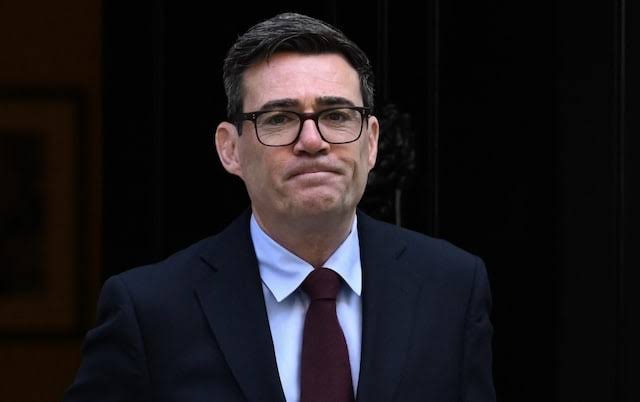
Andy Burnham has come under criticism after a Conservative MP accused him of failing to respond to calls for an important meeting about banning cousin marriages in Britain.
Dr Luke Evans, a Conservative MP and Shadow Health Minister, said he had tried to arrange a meeting with Burnham and Labour ministers to discuss the health risks linked to marriages between close relatives. However, he claimed his request was not taken seriously and that no meeting was arranged.
Speaking to GB News, Dr Evans expressed disappointment over the response he received from Labour. He explained that he had sent an invitation in August, hoping to bring politicians from different parties together to discuss whether Britain should introduce a law banning first cousins from marrying.
According to him, the purpose of the meeting was to look at the possible health consequences of cousin marriages and discuss what the Government could do to protect future generations.
Instead of agreeing to meet, Dr Evans claimed Labour responded by issuing a press statement. He suggested this was not enough, considering the importance of the issue and the concerns he wanted politicians to address.
The Conservative MP believes cousin marriage is a serious matter that should not be ignored because of political differences.
He argued that politicians should be willing to work together when an issue involves public health, children and the wellbeing of future generations.
Dr Evans is now preparing to bring a proposed law before Parliament in January, which would seek to make cousin marriage illegal in Britain.
He said Labour would have an opportunity to show whether it genuinely supports changing the law when the proposal comes before MPs.
According to Dr Evans, the Government will not be able to avoid the issue forever because Parliament will have to consider his proposed legislation.
He warned that Labour MPs could prevent the bill from progressing by speaking for so long during the debate that there is no time left for it to move forward.
This is sometimes used in Parliament to stop private members’ bills from progressing without MPs having to vote directly against them.
Dr Evans suggested that if Labour chooses this approach, it would show that the party had decided not to allow the proposed ban to become law.
However, he also said there was still an opportunity for the Government to support the proposal.
He explained that if Labour gives the bill its backing, it could become one of the relatively small number of laws introduced by individual MPs that successfully pass through Parliament.
Dr Evans said he believes the issue should receive support from politicians across different parties because it is not about supporting the political left or right.
He pointed out that other countries have already considered or introduced measures dealing with cousin marriages, arguing that Britain should also be prepared to discuss the subject.
The MP believes the main concern should be the possible health consequences for children born to parents who are closely related.
Medical research has shown that children whose parents are first cousins have a higher chance of inheriting certain genetic conditions compared with children whose parents are not closely related.
This is because close relatives are more likely to carry the same inherited genetic changes, which can increase the chance of some conditions being passed on to their children.
However, this does not mean that every child born to cousins will experience health problems. Most children born to first cousins do not have serious inherited conditions, although the overall risk is higher.
Dr Evans believes these health concerns provide a strong reason for Parliament to consider introducing restrictions on cousin marriages.
He argued that politicians have a responsibility to consider the long-term effects of the practice and whether changes to the law could help protect children in the future.
At present, marriage between first cousins is legal in Britain, although marriages between certain other close relatives, including siblings and parents and children, are prohibited.
Changing the law would therefore require Parliament to approve new legislation specifically addressing cousin marriage.
The issue has also raised wider questions about personal freedom, family traditions and the role of the Government in deciding who people can marry.
Supporters of a ban argue that the possible health risks justify stronger legal restrictions.
Others believe that education, genetic counselling and better access to medical advice could help families understand the risks without making cousin marriage a criminal offence.
These different views mean the proposed legislation could face considerable debate when it reaches Parliament.
Dr Evans, however, insists that his campaign is not about attacking any particular community or political group.
He wants MPs to focus on the health concerns and consider whether a legal ban would be the right approach.
He also believes the Government should be willing to listen to arguments from different sides rather than avoiding discussions about the subject.
The Conservative MP said his invitation to Burnham and Labour ministers was intended to encourage cooperation and give politicians an opportunity to examine the evidence together.
He expressed frustration that the meeting did not take place, suggesting that Labour had missed an opportunity to discuss the issue before the proposed law reaches Parliament.
Despite this, Dr Evans has made clear that he intends to continue pushing for the ban.
He believes the parliamentary debate in January will be an important moment because it could reveal whether the Government is prepared to support his proposal.
One of the biggest challenges facing his campaign is that the legislation is being introduced as a private member’s bill.
Unlike Government bills, which are usually given more parliamentary time and support, private members’ bills are introduced by individual MPs and often struggle to complete all the stages needed to become law.
Figures covering the period between 2010 and 2024 show just how difficult the process can be.
During those years, more than 2,500 private members’ bills were proposed in Parliament, but only 110 received royal assent and officially became law.
This means that even if Dr Evans receives support from some MPs, his proposal could still fail unless it is given enough parliamentary time and political backing.
Government support can make a major difference because ministers have greater influence over parliamentary business and can help legislation progress through the necessary stages.
Dr Evans is hoping Labour will recognise the importance of the issue and support the proposed changes.
He said he believes MPs from across the House of Commons should be able to agree on measures intended to protect future generations.
For now, the disagreement has added to the debate over whether cousin marriage should remain legal in Britain.
Dr Evans has made his position clear and wants the practice outlawed, while the Government’s response to his proposed legislation will become clearer when Parliament considers it.
The January debate could therefore become an important test of whether there is enough political support to change the law.
Although Dr Evans has criticised Burnham and Labour for not attending the meeting he requested, the account provided does not include a detailed explanation from Burnham about why the meeting did not take place.
What remains clear is that Dr Evans intends to keep campaigning for a ban and wants politicians to take the possible health consequences of cousin marriages seriously.
Whether his proposed law succeeds will depend on the level of support it receives in Parliament and whether the Government is willing to help it move forward.