Donald Trump’s Chilling 2-Word Phrase Should Raise A Red Flag To Women Everywhere

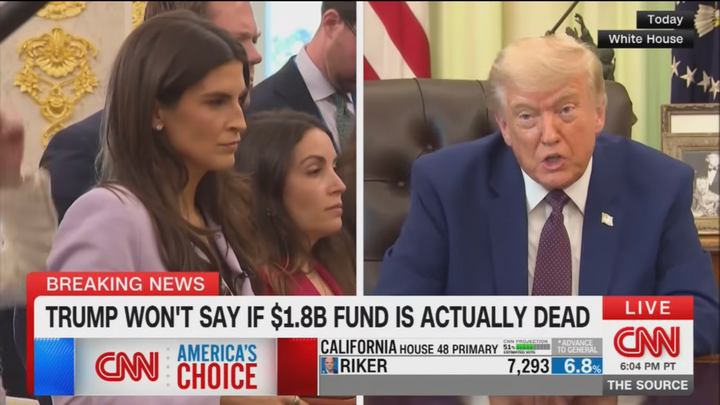
A tense moment unfolded in the Oval Office on Wednesday night when President Donald Trump clashed with CNN journalist Kaitlan Collins during a press briefing. The exchange quickly became heated after Collins asked Trump whether his proposed $1.8 billion Anti-Weaponization Fund had been cancelled or simply put on hold.
Before answering the question, Trump turned his attention to Collins personally. He called her a “corrupt reporter” and criticized her appearance, saying that he never sees her smile. He described her as a young and beautiful woman but claimed that she always looked angry whenever he saw her. According to Trump, he often sees what he believes is hatred in her eyes when she reports on him.
As Collins tried to continue asking questions about the fund, Trump blamed CNN and what he calls the “fake news media” for creating confusion around the issue. When Collins attempted to point out that many Republicans had also raised concerns about the fund, Trump interrupted her. He told her to “be quiet” and said she should be ashamed of herself.
CNN later defended its journalist. A spokesperson praised Collins for her reporting, describing her as a dedicated and skilled journalist who works hard to cover important stories from the White House and beyond. The network said audiences around the world trust her reporting because of her professionalism and persistence.
The incident has sparked renewed debate about how political leaders treat journalists, particularly female reporters. Some language experts argue that telling someone to “be quiet” goes beyond simply disagreeing with them. They say it shifts the focus away from the actual question being asked and instead challenges the person’s right to speak at all.
Linguist Karen Stollznow explained that when someone says “be quiet,” they are not addressing the facts, evidence, or arguments being presented. Instead, they are attempting to control the conversation by shutting down the other person’s participation. According to her, there is a significant difference between saying someone’s argument is wrong and suggesting they should not be speaking in the first place.
Experts say this kind of language can send a powerful message to everyone watching. It may suggest that one person believes they have the authority to decide who gets to speak and who does not. In a democratic society, critics argue that challenging questions from journalists are an important part of holding leaders accountable.
Some observers believe Trump’s comments toward Collins are not unique. They point to several previous occasions when he has spoken sharply to female journalists. In November, he told Bloomberg reporter Catherine Lucey to be quiet while she was asking a question. Months earlier, he also snapped at NBC journalist Yamiche Alcindor during another exchange with reporters.
Critics argue that these incidents reflect a broader pattern in how women in journalism are treated. Soraya Chemaly, a journalist and activist who studies gender and politics, said that such comments should not surprise anyone because they have happened repeatedly over the years. In her view, the issue is not only about individual journalists but also about attitudes toward women who ask challenging questions in positions of authority.
Another point that drew attention was Trump’s repeated criticism of Collins for not smiling. Earlier this year, he made similar remarks during another White House exchange, suggesting that she did not smile because she was not telling the truth.
Experts say comments about smiling carry their own implications. While “be quiet” focuses on controlling speech, telling a woman to smile more focuses on her appearance and emotional expression. Critics argue that women are often expected to appear pleasant and cheerful, even in professional situations where they are simply doing their jobs.
Some analysts note that men are rarely told to smile in the same way. CNN anchor Anderson Cooper pointed out that several male journalists were standing nearby during the exchange and none of them were smiling either, yet Trump singled out Collins for criticism.
The broader debate raised by this incident goes beyond one confrontation between a president and a reporter. Supporters of the media argue that journalists play a vital role in questioning those in power and seeking answers on behalf of the public. Critics of Trump’s remarks believe that attacks on reporters can discourage accountability and transparency. Supporters of Trump, however, often argue that he is simply pushing back against media organizations he believes are unfairly critical of him.