
‘MAGA’ Has A New Meaning After Donald Trump’s Reflecting Pool Mishap And It’s Hilarious

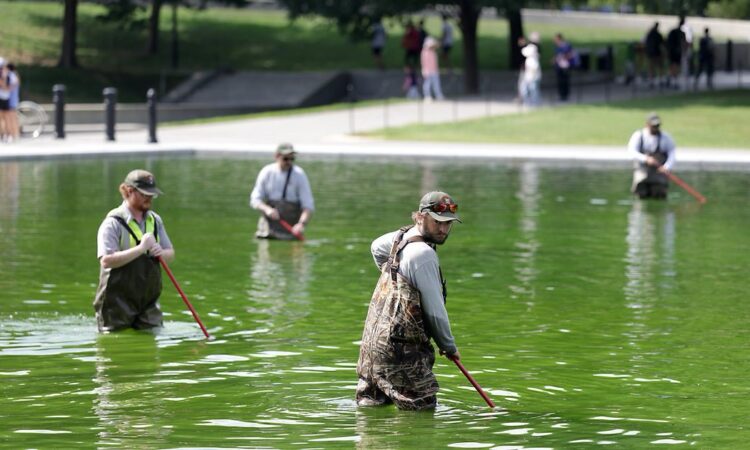
President Donald Trump’s $14 million renovation of the famous reflecting pool at the Lincoln Memorial is facing growing criticism after the water quickly turned green with algae, raising concerns that experts had warned about before the project even began.
The renovation was meant to improve the appearance of one of America’s most well-known landmarks. The reflecting pool was drained, repainted, and refilled with the goal of creating clear, bright blue water. Trump described the new colour as “American flag blue” and hoped it would give the pool a cleaner and more attractive look.
However, only a short time after the work was completed, the water became covered with green algae. Many visitors have compared its appearance to “split pea soup” and even “puke green.” The situation has also sparked jokes online, with people using phrases such as “Make Algae Great Again” and “Make Algae Green Again.”
Environmental experts say they are not surprised by what has happened. They warned from the start that simply repainting the pool would not solve the real problem. According to earlier reports, the renovation focused mainly on cosmetic improvements, while the ageing pipe system and other infrastructure issues that contribute to algae growth were not fully addressed.
As workers race to improve the water before the Fourth of July celebrations and America’s 250th anniversary events in Washington, experts say the task is becoming increasingly difficult.
Sarah Goodrich, an adjunct professor of geography at the University of Cincinnati, explained that algae naturally thrive when temperatures are high and water remains still. She said warm weather, stagnant water and nutrients such as nitrogen and phosphorus create perfect conditions for algae to grow rapidly.
Steve Goodale, a swimming pool specialist with years of experience, said this type of growth is completely natural in large bodies of still water.
He explained that whenever water is left without constant movement, plants and algae begin to grow, whether it is in a decorative reflecting pool, a pond or even a swamp. Because the Lincoln Memorial reflecting pool holds around 6.5 million gallons of water, keeping algae under control is an enormous challenge.
Experts also believe one part of the renovation may have unintentionally made the situation worse.
The pool was painted a much darker shade than before. According to Goodale, darker surfaces absorb more sunlight, causing the water to heat up faster. Warmer water provides even better conditions for algae to multiply.
He said the darker colour means officials are now facing a much tougher battle than they would have with a lighter-coloured surface. While it is still possible to control the algae, the process becomes far more difficult because the water naturally stays warmer for longer periods.
Goodrich added that if even small amounts of algae were already present when the pool was refilled, the combination of warmer temperatures, increased sunlight and any nutrients in the new paint could have allowed the algae to spread much faster.
Some paints contain nutrients such as nitrogen and phosphorus, which algae use as food. Although it has not been confirmed whether the paint used in the reflecting pool contains these substances, experts say it could have contributed if those ingredients are present.
As photographs of workers trying to clean the pool spread online, some Trump supporters claimed political opponents may have deliberately thrown algae into the water to embarrass the president.
Pool experts strongly rejected that theory.
Goodale said no one would need to sabotage the pool because algae naturally enter open-air bodies of water through the environment. Wind, rain, dust, pollen, birds and many other natural sources constantly introduce algae into outdoor water.
He explained that even if someone dumped large amounts of algae into the pool, it would make little difference because algae only continue growing when water conditions allow them to. The real issue, he said, is water chemistry, not deliberate sabotage.
Katie Martin, a spokesperson for the Interior Department, suggested that some of the algae may have come from water left inside unused pipes during the renovation.
Goodale acknowledged that leftover algae inside old pipes could contribute to the problem but said he believes the water would probably have turned green anyway because the overall conditions strongly favour algae growth.
In an effort to stop the bloom, workers have been pouring hydrogen peroxide into the reflecting pool while also relying on a newly installed nanobubbler system.
The nanobubbler adds oxygen to the water through ozone technology, helping improve water quality in a way that is considered environmentally friendly. Experts say increasing oxygen levels can slow algae growth and is similar to the natural cleaning process that happens when waterfalls aerate lakes and rivers.
However, because the reflecting pool remains open to pollen, bird droppings, leaves and other natural contamination, keeping the water clean remains extremely difficult.
Goodale believes the hydrogen peroxide is being used to quickly reduce the current algae bloom while officials hope the nanobubbler system can prevent it from returning.
Hans Paerl, a marine and environmental scientist at the University of North Carolina, agreed that hydrogen peroxide may temporarily reduce algae, but warned that it only remains effective for a short period before breaking down into ordinary water.
Because of this, he said multiple treatments would likely be needed throughout the summer, making the process expensive and difficult to maintain.
He also warned that although hydrogen peroxide is generally less harmful than chlorine, the concentrated solution being used by workers could cause burns if people or animals came into direct contact with it.
Experts say another long-term challenge is the changing climate.
Paerl explained that algae thrive in hot weather, and Washington experiences some of its highest temperatures during the summer months. As temperatures continue rising because of climate change, algae blooms are becoming more common and lasting much longer than they did in previous decades.
He noted that countries and regions that rarely experienced algae problems in the past, including parts of northern Canada and Nordic countries, are now seeing blooms appear far more frequently because warmer conditions allow algae to survive and spread.
Scientists say the growing periods for algae are becoming longer each year, starting earlier in spring and lasting well into autumn. As a result, experts believe authorities may have to carry out algae removal work at the Lincoln Memorial more often in the future unless more permanent solutions are introduced to address the underlying causes.